But I saw a post on the Pittsburgh Post-Gazette’s blog this morning that got me very excited for the youngsters in our nation whose parents force-feed them PBS programming.
“Mr. Rogers’ Neighborhood” has been reincarnated, and it has been renewed. For a second season.
Daniel Tiger is carrying on the legacy of trolley-riding, sweater-wearing and loving thy neighbor.
You might remember Daniel Tiger’s father, Daniel Striped Tiger, as this furry creature, who lived in a grandfather clock and had to learn how to come of his proverbial shell. But Daniel Striped Tiger also had some common sense – he wore a watch, because “when you live in a clock you really should know what time it is.”
Cred.
Daniel Striped Tiger is now married and has children, and I imagine he is a gym teacher at Allderdice High School and his wife is a nurse at UPMC, and their family lives in a sweet bungalow in Squirrel Hill, just a few blocks from Chatham College and a few steps from a PAT bus stop, also a quick walk to Eat N Park on Murray Avenue.
His son, Daniel Tiger, is carrying on the legacy that Fred Rogers left his dad.
***
Even though I am a professed Muppets girl, I had one brush with Mr. Rogers himself when I went to college in Pittsburgh. As an intern at Pittsburgh Magazine, I worked in a large office space in the same building as the studio for “Mister Rogers’ Neighborhood” – a Pittsburgh institution. Each day my fellow interns and I walked to the tiny lunchroom, only a few yards away from Mr. Rogers’ studio. Some days we got daring and walked into Mr. Rogers’ kitchen with the industrial-grade stoplight, or we admired the tree that was the home of X the Owl.
But we never saw Mr. Rogers.
One afternoon I left work and walked towards the University of Pittsburgh to catch my shuttle. As I went to cross the entrance of a parking lot, I noticed a Ford sedan pull up and I stopped before crossing the street.
I learned that on Mister Rogers’ Neighborhood.
Who was driving the car that stopped? Mister Rogers.
I made eye contact with him and he tilted his head, then smiled and waved as if to say, “Hello neighbor!”
I waved back before Mister Rogers left. It was the coolest moment of my junior year of college.
I didn’t have to wait for NBC to air its tape-delayed coverage of the 2014 opening ceremonies of the Winter Olympics in Russia. The beauty of CBC (and a local cable company’s dispute with a national network provider) allowed me to watch in real time the athlete procession, the light shows, the omitted/non-broadcasted portion about the fall of Communism …
Per CNN.com, there are more than 2,850 athletes from 88 countries participating in this year’s Games, and this – http://www.sochi2014.com/en/teams – is a really cool interactive graphic that illustrates each country that will be represented in Sochi.
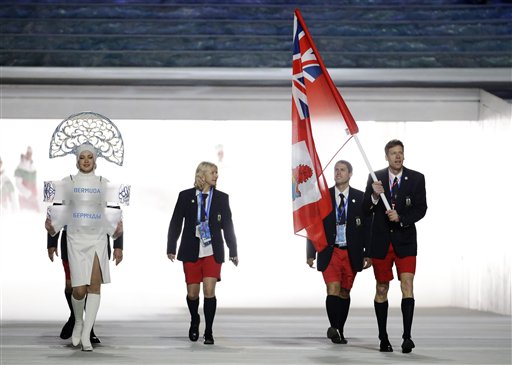
But this is my favorite part of the opening ceremonies.
Bermuda.
Kyrgyzstan. One athlete from Kyrgyzstan.
Jamaica
Even Iran has team of five athletes – including two female skiers who wear the hijab, the traditional Muslim headscarf.
To me, this is the Olympics. Not the hundreds of athletes who represent the slam-dunk medal countries such as the Russia, Norway and the United States (and don’t get me wrong, I love my country), but the men and women who are the tiny contingent that represent a country we might not be able to immediately locate on a globe, and countries you might not think have an interest in winter sports.
It’s the non-traditional countries and the countries who send only a handful of athletes – Chile, Peru, Dominica, Tonga …
Even the independent Olympians – athletes from India who cannot compete under the Indian flag because the IOC would not allow an Indian delegation to Sochi. The IOC suspended the Indian Olympic Association for electing officials who were facing charges of corruption.
It’s supposed to be global and, yes, in a sense, political. But also inclusive. For some athletes, this is the pinnacle of their sport. This is their chance to represent their country on a universal scale.
This week began as a blank slate. Literally. I had nothing to work on, nothing to write about and a project I’ve started has unexpectedly stalled. So I started sifting for story ideas, and somehow, something made me think of Bracken Kearns.
Kearns played hockey in Toledo for only one season, his first professional season in 2005-2006. He didn’t make it to the NHL until the fall of 2011 – when he was 30 years old. His was a story of perseverance and setting goals and staying a certain course – even if that course went through six seasons, two minor leagues and seven different teams.
Something prompted me to call the San Jose Sharks media relations department Monday afternoon to put in a request to speak to Kearns. It was something I’d thought of during the spring, if the Sharks happened to meet the Red Wings in the Western Conference Finals, but that didn’t happen.
Within a day, the Sharks media relations office put me in touch with Kearns. And the first thing I told him? “You’ve got a great story of dedication and perseverance, and people in Toledo want to know how you’re doing in the NHL.”
***
I have a bit of a personal stake in writing about Bracken Kearns, as well – and I didn’t really mention this to anybody as I was pursuing this article.
I got laid off from my job at the Portland Press Herald on Oct. 13, 2011, and I was really, really down – I’d just lost what I thought was the best job ever, covering college and pro hockey and making a good living doing so. Someone else decided that all the work I did and the investment I made in 13 years in journalism didn’t matter anymore. And it felt like after I got laid off, that it didn’t matter that I still had goals I wanted to reach and dreams I wanted to fulfill as a reporter.
I was down. Really down.
A week later, I read about Kearns *finally* being called up to the NHL with the Florida Panthers – it was such an inspiration! His pursuit sent a message to me – to never give up on something you love to do – and it reminded me of one of my favorite movie quotes:
It was a dreary day in Toledo today, 12 degrees and a light snow coming down as I made the drive home. As I turned onto Michigan Avenue, the Billy Joel CD my husband bought me for Christmas (along with Billy Joel concert tickets) flipped to “Allentown.”
It was one of my favorite songs growing up, probably because it was one of the first music videos that MTV played in heavy rotation. It had a cinematic flair to it – and it told a story, something that’s lacking in music videos today. (Yes, they still make music videos – go to Vevo.com.)
(Though I have to say that when I was seven years old, the dude dancing around in his underwear with a flaming baton in that video freaked me out a little bit. One of the funniest passages in the book “I Want My MTV” is Billy Joel discussing the video.)
But I listen to the song nearly 30 years later and it resonates with me on a different level, living in a Rust Belt city that’s gone through despair and is trying to re-discover its identity.
And I realize why it resonated with my parents, who grew up in western Pennsylvania – “Allentown” isn’t just about a town in eastern Pennsylvania. It’s the story of a town that once thrived on industry, on coal mining and working in the steel mills, in the plants and factories, of immigrants who wanted to provide a good life for their children, but a town that lost its identity with the changing economic and industrial times. Pittsburgh, Cleveland, Buffalo, Toledo, Detroit, Youngstown, Erie – you can say that for just about any Rust Belt city. Especially Detroit – a place that was once vibrant and the hub of American manufacturing, but is now a shell of itself. And I hope that Billy Joel comes in and rocks “Allentown” when he’s at the Palace next month, because somehow that will resonate with Detroit, too.
***
Sidebar: Billy Joel sang one of the best renditions of the Star Spangled Banner in 2007, before the Super Bowl.
I remember watching this and thinking, these guys are playing in the game of their lives – no better way to explain it than when the camera held for a few seconds on Indianapolis Colts center Jeff Saturday and Chicago Bears defensive tackle Tank Johnson.
The Real World is in its 29th season. It’s 29th season!
It’s one of two television shows that I followed from my teenage years into adulthood – that and “ER.” I cried during the final three hours of “ER,” both the retrospective and the series finale, but I don’t think I’ll be shedding any tears once the latest cycle is over. MTV might think it’s onto something by putting seven strangers picked to live in a house … and bringing their ex-boyfriends and ex-girlfriends in after thirty days.
Find out what happens when they stop being polite …
Hot tubs, crying, twerking in your nightie with no undies, making out, making up, hitting a roommate with a metal frying pan … and exes having sex. And fights.
This is what the “Real World” franchise has come to?
Watching the season debut made me think of some of the notable moments of the Real World. And not just the notable moments that made the mainstream news: Stephen slapping Irene as she got in the car to leave the Seattle flat, Ruthie drunk driving and Ruthie getting her stomach pumped in Hawaii, Pedro’s wedding in San Francisco (the first televised civil union), Tami announcing she was pregnant to her housemates during a rock-climbing outing in Los Angeles, and Julie and Kevin’s fight over race relations on a city street in New York – the first, the best season of “The Real World.”
So it got me thinking …
The Real World was so much better when Elka proclaimed that she was a virgin in Boston. And when Kaia and Ruthie made out in Hawaii.
The Real World was so much better when Melissa danced topless at a strip club in New Orleans. For money. And when Karamo told M.J. in Philadelphia that he was gay.
The Real World was so much better when Sarah, Dan and Flora spied on Mike’s shower threesome in Miami.
Trishelle’s pregnancy scare in Las Vegas – everybody was talking about that. Even the guys on ESPN’s PTI brought up — and that’s when it crossed the threshold.
I had a boyfriend in college who professed that he hated the show and tried to convince me everything that was wrong with The Real World.
This wasn’t something to be angry about – it, strangely, was the gallivanting that we wanted. To live in a co-ed house, to go out to fantastic clubs and parties and on a trip to somewhere warm and exotic, to be able to sit in a room and confess to the world how you really felt about the people who lived with you and the problems you confronted.
But the intrigue wore off. After that, The Real World tumbled downhill. The “formula” continued to be recycled: hot guy, hot girls, thrown together in a fabulous house and given a job and had their lives taped. And it lost its luster.
Still, it’s like a drug. I’m going to keep watching.
I’m so sorry, but this relationship has to come to an end.
We were together for nine months. Together through snow, rain, in sun, down in the dry heat of Arizona and through the city of Hartford, past the civic center – and you didn’t laugh at me when I started singing Brass Bonanza. Almost everyone else does.
Our first 5K? We made it!
Our first five miler? That was bliss. Frigid, drizzly bliss. We’d finally outdistanced ourselves and broke a barrier. This was the beginning of a long future.
But looking back, going that distance was the pinnacle of our relationship. Because it started to hurt. Literally hurt. My right heel was in constant pain for about two weeks and we had to be separated because of it. I looked at you longingly in that time, knowing we would be back together soon.
When that time came, I tried to put something more into this – a hard heel insert in my right shoe – to make these miles a little less painful.
Then, when we went to Phoenix together, something else happened. Two little holes on the outer edge of the fabric that’s kept it whole. Still, we went out two more times on the roads, and made it work for just a couple more weeks.
Finally, someone else consoled me, but was frank with me. This, Dina at the running shop told me, bending you in half so that the top of the heel met the top of the toe, isn’t going to work any longer. You need something more stable, something that you can invest in.
I needed about an hour to make up my mind.
So I’m letting you go. I’m giving you up and finding a newer, brighter, firmer future in something like you.
I’m putting you in the shoe donation box at Dave’s Running, because I know that way you’ll find a good home in a new life.
It’s been fun. It’s been real. It’s time for me to move on to something new. Thanks so much for the memories, and for helping me realize that I can be a better person. And that I can run five miles.
41.626177-83.582648
I just finished reading John Green’s “The Fault In Our Stars” at the recommendation of Jeremy, whom I refer to as my cousin because we share the same last name. And it’s not a common last name.
Jeremy is using this book as part of his high school English curriculum and it’s a sharp deviation from the books I was told to read during my four years of high school, such as:
“Night,” Elie Wiesel
“Native Son,” Richard Wright
“The Glass Menagerie,” Tennessee Williams
“A Farewell To Arms,” Ernest Hemingway
… to name a few.
Though I cried and cried when Catherine died in “A Farewell to Arms,” it wasn’t a novel I clamored to read again. Nor were the “classics” that were listed on our syllabus each semester.
I can think of one book from all of the assigned high school English classes that I absolutely loved.
Not J.D. Salinger’s “A Catcher in the Rye.” Not Harper Lee’s “To Kill A Mockingbird” – though both had the intrigue and life lessons.
It was “A Separate Peace,” by John Knowles.
Because there were elements I could relate to.
Friendship, loss, going through the same experience together, growing apart, growing up. Rivalries – at one point Phineas and Gene became frenemies, which changes the course of their friendships – and their lives.
John Knowles told the plight of the teenager, even though it was 1942. It was more relatable than going down the Mississippi River on a raft or punishing a woman for committing adultery.
Anyhow, it got me to thinking: we need to incorporate more YA fiction into the educational curriculum … because this is what students relate to. There was a really good piece in last week’s editions Washington Post about the graphic novel as an educational tool and the author’s premise came down to this: don’t rule out a book just because it’s not of “the norm.”
If there’s anything I don’t mess around with, it’s drinking and driving. While I have not personally been affected by a drunk driver, I have seen too many people somehow get into more trouble than it’s worth because they drank and decided to drive away rather than call a cab or ask a sober friend to give them a ride home.
The latter two options are much, much cheaper than the cost of a DUI. Have you ever seen the totals for court costs, legal/lawyer fees, et al for getting arrested for drinking and driving? It could finance a starter home or pay for an economy-sized car. Or a luxury weekend in Las Vegas.
So I went out with a few coworkers tonight and there was a woman there who clearly had a lot to drink. She’d had a rough go of it as of late and I understand the need to blow off some steam and have a drink or two. We’ve all been there. But this woman had crossed a certain line and a few of us, in an effort not only to end the conversation but to send her on her way, agreed that we’d call her a cab so she would get home safely.
She insisted she wasn’t drunk. We insisted she take a cab home. We even called the cab and attempted to pool cash together.
She excused herself to go to the bathroom as we did this and a few minutes later, I saw her sprint out of the bathroom and out the door of the bar. Grown women DO NOT sprint out of a bar … unless they’ve had several drinks or are trying to get away from a creepy stalkerish man. The only man around was a married man. She’d had several drinks.
We were all stunned. I wasn’t going to have that on my conscience. So I ran out the side door, into the parking lot and started screaming at her as she got into the door of her silver SUV.
“JILL! DON’T YOU DARE GET INTO THAT CAR! YOU’VE HAD AN AWFUL MONTH, AND IT’S GONNA GET WORSE IF YOU START THAT CAR!”
She got into the car. She drove away. I canceled the cab. I have no idea if she made it home.
Nelson Mandela’s impact didn’t truly resonate with me until I visited Italy two years ago and became friends with a woman who was born in South Africa but emigrated to Australia. I asked her, “Why Australia?” My friend: “Because of apartheid.” I was speechless. I wanted to continue the conversation with her but we were interrupted by something, and it never came up again.
Apartheid – racism by law – wasn’t something I had ever been introduced to first-hand, in spite of the fact that I’d gone to high school with a (white) South African family and worked with a (white) South African man in college. I’d only read about it in books and news magazines.
This was the other side. And I wanted to find out more, but never did. We didn’t speak of it further, but instead formed a fast friendship during the tour of Italy, based upon the fact that we were both outgoing people who shared similar interests and a certain wanderlust. Yet I had put a face to apartheid. It was not how I expected it to be, a wonderfully funny woman who spent her life helping others and finding the good in them.
***
Apartheid is institutionalized racism. And I thank God now that it has been legally abolished in South Africa for nearly 20 years. The minority white ruled the government. Whites and blacks could not marry in South Africa. Native men and women were forced to live in shantytowns, and lost their basic human rights. If you ever watch the movie “District 9,” it is a sharp, sharp metaphor to what happened in South Africa for nearly 50 years.
Mr. Mandela chose to stand up against the hatred and the laws that kept his countrymen – regardless of their color or social standing – from truly being free. He was jailed for 27 years, essentially for leading an uprising against his government in South Africa. He wanted what was right, not what was written down. He was punished. He found peace in prison and when he was released, he became an advocate for human rights.
My first introduction to apartheid – no joke – came through MTV. During the 1980s and 1990s, the iconic cable music channel aired videos in which musicians took a stand, whether it was Madonna’s “Papa Don’t Preach,” or U2’s “Sunday Bloody Sunday” or Midnight Oil’s “Beds are Burning.”
Musicians took on apartheid, as well. I’m watching this now and going, “yo, Hall and Oates! … Silvio Dante! … Rev Run! … P-Funk! … The Boss!”
But these musicians were sending a political message.
As an elementary school student, I didn’t know what was going on thousands of miles away, I didn’t know where Sun City was and I didn’t have a clue about apartheid, but I knew this: Little Stevie, George Clinton and the Fat Boys were telling me something was wrong, and they wanted me to do something about it, or at least to care.
***
I had a teacher in the seventh grade – Miss Raleigh – who traveled the world and who was one of the first instructors who encouraged students to think for themselves and to understand the world around them. The great thing about Miss Raleigh was that not only did she want her students to embrace their own gifts, but she wanted us to know what was happening in places other than in our classroom or in the Annapolis area and why we should care. She wanted us to be global and to realize that the same values we had here in the U.S. could be shared across countries and cultures. It’s like my dad says – “we’re all different, but we’re all the same.”
She wanted us to raise money and to donate to UNICEF. She wanted us to make posters about different parts of the world and what we didn’t know about them. She wanted us to know who people like Yasser Arafat, Indira Gandhi, Benito Mussolini, Mikhail Gorbachev and Nelson Mandela were – that they weren’t just people whose faces we saw on the cover of the magazines our parents subscribed to, or the faces we saw on the news.
She wanted us to be able to express our thoughts, feelings and opinions on what was happening in the world.
Miss Raleigh’s seventh grade social studies class? That’s when I truly learned what this whole apartheid thing was about. Much like our country – only on a sadder and bigger scale – one country was still implementing racism, which was wrong. Wrong. This was less than 30 years after the Civil Rights Act took effect in our country and Miss Raleigh was still angry and saddened by what was going on halfway around the world. Her classroom was one of the few places where I’d ever seen an instructor shed tears. After we watched a movie about apartheid, she asked us why we thought what was happening in South Africa was wrong – or why it was right. We knew it wasn’t right. She cried for the wrongs of the world, and I know she wanted us to understand those wrongs as well – she knew we had some kind of power not so much to change the world but to change our own perceptions.
***
Today, Nelson Mandela died.
Right now CNN is showing footage of people dancing, singing and chanting for Mr. Mandela outside of his home in Johannesburg. A white woman and a black man have their arms around each other’s shoulders. An Indian or Indonesian woman, maybe, has crossed across the camera. Another white woman is holding a black baby. An Asian person is videotaping this on his BlackBerry. A black woman is dancing. The ubiquitous South African flag is waving above everybody. It makes you appreciate humanity.
Without Mr. Mandela, without his self-sacrifice, his selflessness, his desire to unite people and to eliminate the wrong that affected his nation … we wouldn’t have any of this.
41.626079-83.582672
As you probably know, I’m very anti-bullying and very pro-empathy. Sometimes I’m a little too empathetic.
It’s a power thing, too – a person is so certain of his or her own self-importance, yet has no self worth, or are threatened, and gain a false sense of entitlement by belittling someone else.
A colleague of mine groaned and made a comment about the “wussification” of America, and I thought, well, how would you feel if someone belittled you every day?
Heck, at my last workplace, I had a bully, and I was hesitant to stand up to the bully for fear of “upsetting the apple cart.” Finally, a male coworker recently told me, “I’d never have let it get to that point.” And at that point, I felt as if I’d been granted permission to stand up to workplace bullies. Not that I haven’t stood up to people before, but I finally had a coworker put himself in my shoes.
Among the things I’ve taken from the Incognito-Martin feud: Male bullying is overt, while female bullying is covert.
Girls wouldn’t tell another girl that they’d shit in their mouth. They’d tell them their lipstick made them look too pale. Or they wouldn’t invite them out, when they’d invited everyone else out. Or that the story they worked on wasn’t worthy of being run on A1, despite all the hard work that was put into it. That’s something the bully at my last workplace did.
I’ve forgiven her for being such a horrible coworker and for behaving horribly towards me, and I know I didn’t do anything to provoke her. Sometimes I wish I would have just cornered her and asked her what her problem was with me. But there’s one thing I think of when someone brings her up to me. (I won’t name the woman who bullied me in the workplace. She knows who she is. That’s on her conscience.)
Charlie Batch, a former NFL quarterback, recently posted this on his Facebook page. There’s truth in this statement from Maya Angelou:
“I’ve learned that people will forget what you said, people will forget what you did, but people will never forget how you made them feel.”
And that’s the problem with bullies. They likely never consider how someone else feels. Their only concern is for their own feelings.






 "Where we're going, we don't need roads."