Nobody wins

One college student is dead.

Another could be going away for a long, long time.

George Huguely was painted as a drunk, overprivileged athlete whose heinous transgression came in the heat of passion – in legalese, that’s voluntary manslaughter.

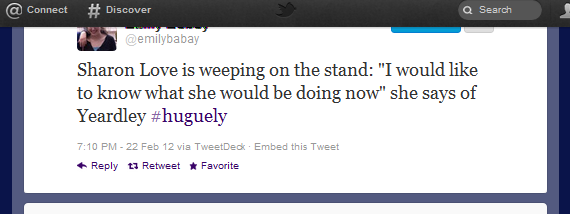
But Wednesday night, Huguely was convicted by a jury in Charlottesville, Va., of second-degree murder and grand larceny. His sentence for the 2010 killing of Yeardley Love has not yet been determined, but after 7 p.m. Wednesday night, Love’s mother and sister spoke as sentencing witnesses in court.


Huguely’s father, according to several media reports, was not in court on Wednesday. During sentencing, nobody testified on Huguely’s behalf.

***

When I learned of the verdict, I didn’t shout or leap in the air … or even celebrate in any way. What is there to celebrate? It was a sad moment. Not even bittersweet. Learning the verdict against Huguely left me with a strange, empty feeling.

Because Love’s death could have been prevented.

Because Huguely’s behavior and his actions could have been stopped.

Because there’s another man out there who abused a woman to the point of death, and his actions and her death won’t receive as much attention.

Who wins? What did anybody win?

Yeardley Love is dead.

George Huguely will go to prison. Legally, he has been branded as a murderer.

Really. Who wins?

***

If someone finds anything from this, I hope it is the girl who wants to walk away from her abusive boyfriend. She will.

Or the lacrosse/baseball/football players who know their teammate has a problem, but has to find a way to confront them. They will.

Or the kids in high school who are targeted and picked on by the “cool kids” for being different – because at my high school, George Huguely would have been one of the “cool kids.” They have the power to stand up for themselves and to be compassionate towards others. They will.

I hope Yeardley Love’s family and friends can find some closure in this. And, more importantly, I hope they can find some kind of peace in this judgment.

Here we go again, BU

So. A few days after Boston University announces it’s adding men’s lacrosse as a varsity sport …

… Max Nicastro, a junior on the BU hockey team, gets arrested on sexual assault charges and is suspended indefinitely. It’s the second such arrest this season of a BU hockey player. Nicastro joins Corey Trivino in that hall of shame.

And Nicastro’s arrest comes less than a week after the championship game of the Beanpot, when Terriers, Boston College, Northeastern and Harvard wore white ribbon stickers on their helmets, as part of a campaign against violence towards women.

Now, really, do you think Max Nicastro was listening? Or was aware? Or, when he allegedly committed the assault he’s charged with, was he just too drunk to make the “right” decision?

(If you’ve been paying attention to the George Huguely V case, this is pretty much the defense’s argument in favor of Huguely, a former Virginia men’s lacrosse player who is being tried in the death of Yeardley Love.)

Is Boston University’s hockey program sliding down the same slope that Virginia lacrosse and Penn State football tumbled down: harboring and enabling a culture of despicable behavior?

Is the collective behavior of Nicastro and Trivino, as well as a handful of suspensions and arrests over the past three seasons, indicative of  the culture – and what’s permissible, acceptable and/or overlooked – in a program?

Or will fans stick to the belief that winning, ultimately, will simply make up for all these problems?

This is too many

Here’s some food for thought: some information on domestic violence among teenagers and college students that I found while combing through today’s coverage of the George Huguely V trial:

  • About one in three high school students have been or will be involved in an abusive relationship.
  • Forty percent of teenage girls ages 14 to 17 say they know someone their age that has been hit or beaten by a boyfriend.
  • In one study, from 30 to 50 percent of female high school students reported having already experienced teen dating violence.
  • Teen dating violence most often takes place in the home of one of the partners.
  • In 1995, 7 percent of all murder victims were young women who were killed by their boyfriends.
  • One in five or 20 percent of dating couples report some type of violence in their relationship.
  • One of five college females will experience some form of dating violence.
  • A survey of 500 young women, ages 15 to 24, found that 60 percent were currently involved in an ongoing abusive relationship and all participants had experienced violence in a dating relationship.
  • It is estimated that between 20% to 52% of high school and college age dating couples have engaged in physical abuse.

(source: Bureau of Justice Special Report: Intimate Partner Violence, May 2000)

These numbers confound me and overwhelm me. And they sadden me. This is too many …

George Huguely V is being tried for first-degree murder in the death of Yeardley Love, and the trial is raising questions and, more importantly, dialogue regarding domestic violence among high school and college-aged students. It’s something that doesn’t seem to come up, or if it does, it’s an awkward dialogue. And any situation involving domestic violence begs the question: “Is it possible to ask for help?”

Lea Calvani, who works at a Charlottesville, Va., help center and shelter for victims of domestic violence, told a Virginia television station this:

“Statistically it takes a woman 7 and a half to 12 times to leave her partner before she leaves for good. I think that one as a general community, I think we always have kind of the assumption well she should just leave the relationship and unfortunately it’s really not that simple.”

If you’re a victim, are you trapped? No. Absolutely not. Even if you’ve dismissed your boyfriend or girlfriend’s physical threats or you’ve found a way to justify the abuse, there’s a means to breaking the cycle.

But what do you do if you witness it? Do you take it seriously if your friend’s boyfriend hits her? Or if your best friend’s girlfriend sends him a text message threatening to kill him? Do you attempt to run interference? Do you take a picture or shoot video with your cell phone camera for proof? Do you forward that text to someone else? Do you call the police?

Do you – gasp! – cause a scene?

At the risk of patronization … maybe you should. Because there’s no reason to continue to enable that kind of behavior and to condone the attitude that this is all OK. Because it’s not.

Frankly, if this would have happened to a girl I went to high school or college with – or to a boy – I hope to a higher power that one of them would have had the courage to tell the world.

Or did they ever?

Also at fault …

As the trial of George Huguely V ends its first week, I don’t know what makes me angrier. The fact that Huguely beat the crap out of Yeardley Love, or the fact that so many people saw this coming and didn’t go out of their way to prevent an attack and her subsequent death.

To the women who read Huguely’s email to Love, the message that stated that he should have killed her, you are culpable. You pushed aside a threat when you could have aided a teammate and a friend.

To the men who said they would stage an intervention, in light of Huguely’s excessive drinking, you’re in contempt, too. Too little, too late.

Courtroom sketch from the George Huguely V trial, via the Washington Post

Somehow, the behavior was condoned …

via the Washington Post

Being a defense attorney has to be one of the most morally challenging occupations. Chances are, you’re dealing with a person who is guilty of a crime. Your role, somehow, is to either play the devil’s advocate or craft a strong enough defense that somehow lessens the severity of the crime your client has committed … or somehow justifies the crime your client has committed.

If you’re George Huguely, your team of attorneys has gone public with its defense in the Yeardley Love murder case.  Huguely, a former University of Virginia lacrosse player, is accused of killing his former girlfriend in May of 2010. The trial began Monday with jury selection in Charlottesville, Va.

From the Baltimore Sun:

Huguely’s lawyers are expected to argue that Love was taking prescription medication and drinking the night she died, which may have contributed to her death. Huguely has admitted to police that he fought with Love that night, shaking her repeatedly so that her head hit a wall, but he denies killing her.

“It is undisputed that a man hurt a woman. It is undisputed, that is fact,” Rhonda Quagliana, one of Huguely’s lawyers, said during jury questioning. She also said the “cause of death is a contested issue in this case.”

A former college classmate told me that the defense’s job is to find enough doubt in the prosecution’s case.

But the case of George Huguely and the murder of Yeardley Love – academic and athletic products of private schools, part of a close-knit athletic community both at the University of Virginia and in the enclave of lacrosse – expose something deeper: another angle of the underbelly of upper-middle class suburbia.

I know why this resonates with me. Because I knew many teenagers like Huguely and Love – pretty, privileged, popular, athletic, always seemingly surrounded by their “best friends” and their “fellas” and the members of their “clan.” There was a certain sense of elitism that surrounded this small caste, and after the details of the George Huguely case emerged, I wondered something: how did the boys in this artificially powerful caste treat these girls? And how did the girls treat the boys? And how did they collectively treat each other? Did they – with the exception of a few individuals – treat each other how they treated their seemingly lesser classmates?

But the case also hit me in another way: We approach the 20-year anniversary of the murder of one of our classmates.

Yes, 20 years ago this month, the former quarterback at my high school killed another classmate over a girl.

People don’t believe me when I tell the story. The quarterback drove a Corvette, had the cutest girlfriends and was the centerpiece of the best parties … and he killed another guy over a girl. As the months went by, following his arrest, more of us found out from each other about his behavior, both prior to the murder and growing up with us. We witnessed some pretty misogynistic behavior from a teenager yet somehow we socially condoned it. But – and this has been asked in the case of Huguely and Love – how could this all have been stopped?

The case was barely a whisper at the most recent reunion – probably because we were all having such a good time, we didn’t stop to recall the controversy and the tragedy. But in 1992, the case polarized our school. It still polarizes us. Our former classmate pled guilty to first-degree murder and is still incarcerated. Each time he asks for parole, he is met by a group of former classmates who voice their disgust and outrage that, years later, he still asks for a chance at life “on the outside.” At the same time, he has a group of friends who attend each court hearing in his support … and a handful of them who still contend that somehow, the murder was justified.

But what justifies one person taking another human’s life? Better yet, what justifies our decision to condone it? Or to turn the other cheek and condone the actions that lead to such a tragedy?

***

I’m going to add a note to this: if you or anybody you know is a victim of domestic violence, you have the power to do something about the situation. Call the National Domestic Violence Hotline at 1-800-799-SAFE (7233), an organization that will help you or direct you to resources that will help you.

If you’re a teenager or a college student and know someone in this situation, take your concerns to someone you trust: a teacher, a parent, a coach, a school administrator. In the wake of Yeardley Love’s death, I urged my friends and family who were parents, teachers and coaches to reach out to their children, students and athletes and discuss the topic of domestic violence and the social issues that teenagers may confront.

Love, Peace and Soul (Train)

I’d tell you exactly where I was when I learned of Don Cornelius’ death … but in the name of confidentiality, I won’t. However, I’ll tell you exactly what went through my mind as I looked up at the television, tuned to CNN, and saw the text underneath the video of Don Cornelius, in a spiffy black pinstriped suit.

DON CORNELIUS 1936-2012

As a fan of R&B, Motown, soul and hip-hop music, I was shocked to learn of Cornelius’ death as a result of a self-inflicted gunshot wound. I was saddened. A person who bridged a racial and societal gap in pop culture and who revolutionized music was gone.  His legacy will live on in so many episodes of “Soul Train,” a show that needs no words to explain its premise.

If you have Centric TV on your cable, I highly suggest you tune in to old episodes of “Soul Train.” Furthermore, I highly suggest you watch VH1’s documentary on “Soul Train.”

There were two shows I HAD to watch when I was a little kid: “The Muppet Show” and “Soul Train.” Both enriched my desire for sensory stimulation with bright colors, music, audience engagement and interaction. While the Muppets brought alive my love for comedy and satire, “Soul Train” helped create and refine my taste in music.

My parents faithfully watched it, and sang along and danced to the hits that played over our television. My dad has a love for music, and he forged a lot of connections and friendships while working in Prince Georges County in the late 1970s and early 1980s through not only his outgoing, approachable demeanor but also through his appreciation of music and sports.

I grew up in a predominantly white, upper middle-class neighborhood in suburban Washington D.C., where my classmates’ musical tastes drifted more towards Jane’s Addiction, Metallica and Nirvana.

Not my cup of tea, unless it came with two Tylenol and a cold compress.

While my classmates were buying CDs of Pearl Jam and Alice in Chains, I was picking up cassette singles by Karyn White, Mint Condition and Johnny Gill. Instead of WHFS, the Baltimore-Washington alternative station that was in its heyday in the 1990s, the preset dial on the radio of my first car was tuned to WPGC, the Prince Georges County-based R&B station that played everything from Rare Essence to Toni Braxton.

(WPGC newsman David Haines had a saying: “Burnt toast and coffee time.” That was my morning signal to get the hell out of the house and head to school.)

My second preset: Howard University’s WHUR. I still recall my amazement when a high school boyfriend of mine had it pre-set on the dial of his car, too. D.C., by the way, had a killer music scene 20 years ago.

But I’m going off on a tangent. Back to “Soul Train.” Which, yes, I watched and danced around in my living room to, during high school and college.

A Chicago-based show originally broadcast on a small handful of stations, it went into syndication as a result of cooperation with Johnson Products, the creators of Afro-Sheen – a coalition of two African-American entities. “Soul Train” was a conduit brought African-American music into our living rooms and into the mainstream. It showcased not only music but fashion, youth, creativity and a positive environment that encouraged appreciation of all of these things.

When the show exceeded critical mainstream mass, “Soul Train” incorporated traditional white perfomers – Elton John, David Bowie, Teena Marie (who, as ESPN’s Jemele Hill once stated, was the first white girl with soul.) … Bowie’s performance of “Fame” – clearly lip-dubbed – is a thing of strange beauty.

“Soul Train” broke racial barriers and established cultural trends. It promoted the African-American community during a time of racial strife in the United States … and continued to keep its hold on America as our society grew more progressive.

Don Cornelius’ idea not only promoted music – it revolutionized pop culture and created societal connections. Sadly, his death had to remind us of all of this.

How could this have been overlooked?

Yesterday it was revealed that Sidney Crosby’s brain wasn’t just injured – the Pittsburgh Penguins captain had also sustained fractures of the C1 and C2 vertebrae.

Translation: the top two bones in his spinal column were broken.

c/o your-neurologist.com

Which left everyone asking last night – on the eve of the NHL All-Star Game in Ottawa – “how did this happen? Or, better yet, how was this overlooked?”

Because doctors and medical staff may have been so focused on treating one thing – concussions and their lingering symptoms, which had sidelined Crosby for all but a handful of games in a span of more than 55 weeks – that something else that potentially contributed to the problem may have been largely ignored.

Of course, now the world waits for Crosby’s medical team and the Penguins’ medical team to elaborate on this. Or spin it. But that’s another story.

What got us to this point isn’t just a commentary on Sidney Crosby’s health. It’s a reflection of what is happening in medicine and in the treatment of patients right now. Our medical system – its doctors, its insurers, its institutions, its ethics – is under attack and under scrutiny. Who is feeling the trickle-down effect of this? Patients.

I was fortunate to see my husband go through a day-long battery of hospital tests after a recent fainting spell … and a litany of follow-up care to figure out what exactly the problem was. The treatement wasn’t so much efficient as it was thorough.

Yet twice in the past year I’ve had friends who have gone through medical problems, whose symptoms have been misdiagnosed by doctors and re-diagnosed by specialists, resulting in further problems and headaches, literally and figuratively.

In the haste to isolate one problem, another problem was ignored. A problem that could be far more serious. Which brings up the holistic aspect of medicine, one that comes with a certain level of institutional ignorance. When I say “holistic,” I mean it not in the sense of herbs and organic goodness and Whole Foods but in the all encompassing sense: look at the whole and not just the parts.

Do we attribute isolating one medical problem instead of looking at everything to the fact that doctors may be overwhelmed? Do we attribute the lack of this to rising health care costs? To HMOs that hamstring its clients? To the politics that surround medicine?

Or, in a sense, to ignorance?

How many of you have gone to the doctor for one problem, had it diagnosed as one issue … but then a whole new crop of problems arise? Or the problem persists, despite diagnosis, analysis and treatment?

Why has it happened? Is it cultural? We live in a quick-fix society. We’ve got too many other things to do besides worrying about a twisted ankle or a splitting headache, so we seek a form of rapid relief. Some are more willing to oblige than to say, “hey, look, we might want to examine everything instead of just what your one issue is.” Or maybe we demand too much of our doctors. Even I’ll admit that I begged a doctor to give me antibiotics when I couldn’t shake a sinus infection before a weekend of work.

But if you don’t feel like something is right, ask for accountability from your doctor or medical professional. Ask him or her if there’s something else that could be affecting you. Do some research on what’s bothering you and ask the doctor, could it be this? What do you think? Seek a second opinion. Or a third.

Don’t have it get worse and ask yourself, “how could this have been overlooked?”

Consider the principle

I get it, Tim Thomas. And not just because I once volunteered with your charity.

I get it because you stood for your principles. Politics, they are a funny and polarizing entity.

From Tim Thomas’ Facebook page:

“I believe the Federal government has grown out of control, threatening the Rights, Liberties, and Property of the People.
“This is being done at the Executive, Legislative, and Judicial level. This is in direct opposition to the Constitution and the Founding Fathers vision for the Federal government.

“Because I believe this, today I exercised my right as a Free Citizen, and did not visit the White House. This was not about politics or party, as in my opinion both parties are responsible for the situation we are in as a country. This was about a choice I had to make as an INDIVIDUAL.

“This is the only public statement I will be making on this topic. TT”

I can see why you stuck to your beliefs and principles and decided not to go to the White House with your teammates, to be honored by President Obama for winning the Stanley Cup.

Still, the decision not to join the Boston Bruins at the White House today is reflective of some of the decisions we make every day. Its a macro-micro thing.

Think about it: some of the decisions we make are based on our personal principles. We may not go to a party because the host is a sexist pig. Why should I put myself in an environment that will make me uncomfortable? Or we may turn down an offering from a person who lied to us, a person whom we once trusted. Why should I satisfy you when you hurt me and deceived me?

As for Tim Thomas’ decision to take a stand, on the principle that visiting the White House didn’t align with his personal politics?

I’m not endorsing it, condoning it or decrying it … but, as Chris Rock once said, “I understand.”

How will Joe Paterno be remembered?

Joe Paterno died Sunday morning, and he left the world after a span of less than three months in which we witnessed his downfall, the scandal that rocked the Penn State community and Paterno’s rapidly failing health.

His death, as does any, leaves us with questions. While he was not a mystery, his final days were shrouded. In an interview that ran last week in the Washington Post, he admitted this much:

But after 61 years on the campus, Paterno cleared out his office in the space of one day. It was an end he was unprepared for. Yet it came with the realization that as the face of the university, people assign him greater responsibility than other officials.

“Whether it’s fair I don’t know, but they do it,” he said. “You would think I ran the show here.”

Will his abbreviated final season at Penn State – a result of the child abuse sex scandal that centers on former assistant coach Jerry Sandusky, and all of the deception involved in the scandal – mar his legacy?

Was what he told Sally Jenkins the truth? Was he blissfully unaware? Did he have too many other things to worry about than handling something himself? Or did he not know the whole truth and not know exactly what to do when approached by Mike McQueary with information regarding a heinous crime?

Joe Paterno was not a martyr. And he was not a victim. But he was culpable in his own role of the fall of Penn State football, because he had the power to stop the sexual abuse of children at the hands of Jerry Sandusky. He had the power to cement his role – and his worth – as one of the greatest college coaches … but he chose to pass the buck.

For the time being, this may be how we remember Joe Paterno. It’s still fresh in our minds.

And at the same time, he was a certain legend in college football, an innovator, a traditionalist, a winner and a leader with standards. Sometimes, you wondered if Joe Paterno was bigger than Penn State itself.

He was ceremoniously taken away from football, from the routine he followed every weekend for more than 60 years. Did he ultimately die of a broken heart? Or was his health – he died of lung cancer, and suffered a broken hip in his final three months of life –  secondary to what meant so much to him?

How will we choose to remember Joe Paterno? As a college football pioneer? Or as an enabler?

Are you going to consider the standard he set?

Will you take a few minutes give him and his family some dignity? Or will you immediately spit on his grave?

What’s this SOPA all about, anyways?

Thank you, MassLive.com, for this great graphic. (please don't shut me down)


In the past few days we’ve been bombarded with messages regarding SOPA and today, some of our favorite sites have been blocked. Big, black boxes are covering content and keeping us from obtaining something. Information. Some of our favorite Websites are taking a stand against SOPA, the Stop Online Piracy Act.

And while the idea that is SOPA seems effective in theory, it’s not. It’s not a form of preserving originality. It’s another form of the government and big businesses attempting to assert control of information. If it looks like it’s been lifted, we’re taking it back.

This footage of Mario Lemieux’s goal in the 1992 Stanley Cup Final that you’re watching on your lunch break? Or watching, instead of coming up with new ideas?


It’s embedded on someone else’s blog. And taken from YouTube. Under SOPA, the government would believe that ultimately, that footage doesn’t belong to you. So they’re blocking your access to it. Heck, and as today’s story on TheClassical.org states, even YouTube, which hosts that footage, could be subject to SOPA. Because technically, that footage does not belong to them.

Good.is also has a bullet-point summary of what SOPA (and PIPA) is and how it could affect the audience on its homepage.

It’s all hypothetical at this point, and who knows what the future of SOPA holds. Or, after this day of awareness, if it has a legitimate future. But all those black boxes you’re seeing today on some of your favorite sites? They’re making you aware of the issue that confronts us.

So, basically, if this were to come to fruition, the government would have the right to effectively block your domain – and your work. It’s something that could even affect legacy media – many of those institutions are using video, screengrabs, photos and logos in digital media initiatives.

This counters one of the principles our country was founded on and has thrived on – the free exchange of ideas. While SOPA could encourage us to think original thoughts and create original content (um, isn’t that what we should be doing?), in a way, it keeps us from doing that. Consider that new ideas and influences are the birth of previous notions.

How would we effectively access ideas – and information – if our government was, ultimately, controlling our messages?