On Jagr-gate, or why my inner teenager is so conflicted

My father offered me some unsolicited advice in the days before I left to go to college in Pittsburgh:

“If you’re going to date anyone, make sure it’s Jaromir Jagr.”

Truthfully, I had no chance.

But the exchange – now more than 15 years old – was indicative of where Jagr, then a cult hero/NHL All-Star/rock star/hairstyle-challenged/teenage dream stood in the eyes of Pittsburgh sports fans – and of hopeful father-in-laws.

Hence, Jagrmania. Twenty years ago, girls loved Jaromir Jagr. Mothers hated him. Guys wanted to be like him, probably because they envied him. Kit Kat candy bars, Ed Belfour and traffic cops were afraid of him.

But did Pittsburgh fans ever imagine this day?

Jagr returns to Pittsburgh tonight – as a Philadelphia Flyer.

As a hockey fan, do you appreciate what Jagr has accomplished during his time in the game?

As a member of a capitalist society, do you commend Jagr for taking the best paycheck in exchange for the best opportunity to showcase his hockey wares?

As a Penguins fan, are you supposed to hate Jagr for such an act of treason? For choosing Philadelphia over Pittsburgh?

It creates some cognitive dissonance. Especially considering that most of my teenage years were spent watching Jagr work his on-ice (and sometimes off-ice) magic with the Pittsburgh Penguins. Yes, I was one of those big-haired screaming teenage girls in the stands at the Civic Arena in the early 1990s. Those were the halcyon days …

These days, I don’t know if I’d be screaming for Jagr. Or if I’d be screaming at him. Because as I look back at his time with the Penguins, and then courting the Penguins, I’m conflicted. So is my inner teenager. It’s like coming to terms with the old boyfriend who jilted you, then who unexpectedly sent you a friend request on Facebook 15 years later, when you thought he’d been thoroughly purged from your memory. But he wasn’t. And his wife was kind of hot.

*sigh*

Jagrmania, it was.

In 1990, the Penguins drafted Jagr out of the Czech Republic. He went from an 18-year-old who spoke little to no English in his first season to a perennial All-Star, a Stanley Cup champion and a western Pennsylvania heartthrob. Oh, and if you rearranged the letters of his first name, it spelled “MARIO JR.” Some believed he was poised to be the franchise after Mario Lemieux’s premature retirement in 1997.
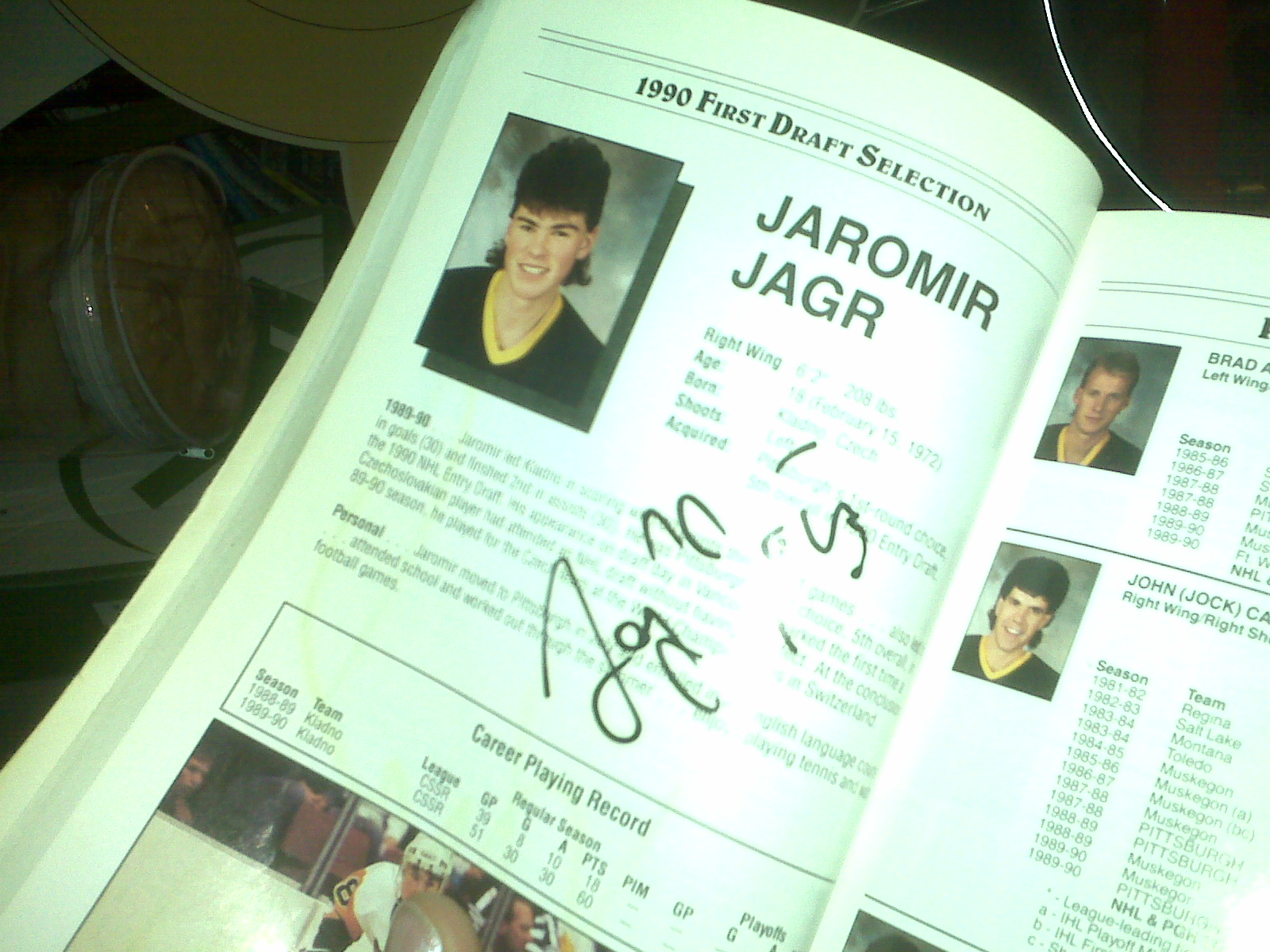
Yes, that's my 1990-1991 Penguins media guide.

But it didn’t work out that way, as he was shipped off to Washington in the summer of 2001, only a few months after the infamous “dying alive” statement.

Still, the love reappeared, nearly nine years later. Jagrmania was back in full tilt in February of 2010 when Jagr returned to North America with the Czech hockey team for the Winter Olympics. Then, it was revived this summer when Jagr openly expressed interest in returning to the NHL after playing three seasons with Avangard Omsk of Russia’s Kontinental Hockey League. It seemed like all of hockey was on watch after Jagr announced his intentions to come back to North America.

Seen in Toronto ...

One of those destinations? Pittsburgh.

And Penguins fans, despite the franchise’s embarrassment of riches, were ready to welcome Jagr back, despite the thorny parting of ways nearly 10 years ago. The thought of Jagr returning to Pittsburgh didn’t just bring about Jagrmania. It brought about full-tilt Jagr Madness.

He thought about Detroit. Considered Montreal. Played the dating game with Pittsburgh … and Jagr decided to go to Philadelphia. Was this right? Was this fair? Was this karma?

***

Jagr returns to Pittsburgh tonight for the first time since the 2007-2008 playoffs, and he met with the media this morning in Pittsburgh, prior to tonight’s Flyers-Penguins game at CONSOL Energy Center.

A sampling of what he said:

From the Philadelphia Inquirer (and when you watch this video, make sure the “Rocky” song is playing in the background):

Jaromir Jagr was not himself Wednesday. The usually gregarious Flyers winger, who won five scoring titles with the Penguins, was mostly agitated during a news conference. He admitted on Thursday that he was upset with how the Pittsburgh media has portrayed him.

“Maybe I overreacted. I’m just not happy with some of the media here,” he said after Thursday’s morning skate. “They make up everything. That was the problem. That’s when they start everything, and it’s tough to control.

“It’s bothered me for a long time, and I was a little bit mad about it yesterday,” he added. “It’s not going to help me, but at least” he relieved his frustration.

Among the things that apparently bothered Jagr were reports that he had agreed to return to Pittsburgh before signing with the Flyers.

From the Pittsburgh Post-Gazette:

Q: Did the Penguins say anything to you or [your agent] Petr Svoboda when they made the offer about what kind of role you would play?

A: Nobody will tell you how they want to use you. That’s one thing. But you can sometimes read between the lines. I’ve got nothing against [Penguins winger Tyler] Kennedy [who was a restricted free agent last summer] or guys like that, but if somebody tells you, ‘Well, we have to wait for Kennedy,’ and he was playing on the third line, well, where am I going to play if you wait for Kennedy before you sign me? I was reading between the lines. Maybe I’m wrong, maybe I’m right. Nobody’s going to know. Bottom line, I am here, you guys are over there. I’m going to come to the game. Everybody’s going to hate me. And I still have to play. OK? Good luck to everybody. See you next time.

“Hate” is a very strong word. Maybe “pariah” is more fitting. Or “persona non grata.”

Despite the money, the fame, the supposed hate … is there some small part of Jaromir Jagr that’s a bit conflicted about tonight?

If so, my inner teenager, swathed in a mustard yellow-and-black jersey, can relate.
Beware of flying inanimate objects

Look out above! It’s a bird. No, it’s a plane. No … it’s a duck. Not that kind of (Anaheim) Duck.

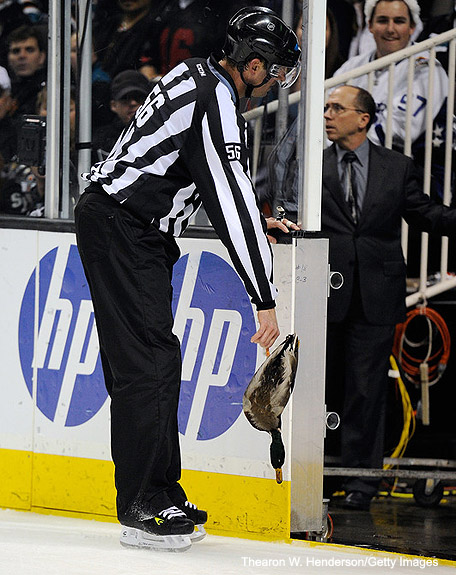
During last night’s Anaheim-San Jose game at HP Pavilion, someone launched a duck. A goose. A honker.

There’s video, courtesy of our friends at Puck Daddy, and there’s a photo of a linesman unceremoniously taking the posthumous goose off the ice.

The tradition of projectiles is nothing new in the NHL. In fact, it’s generally condoned, despite the fact that many facilities and the NHL repeatedly state a rule that throwing things on the ice during a game is prohibited.

Last spring, the NHL issued a crackdown on Detroit’s octopus toss.

That crackdown came a year after a fan tossed a baby shark – with an octopus stuffed in its mouth – onto the ice at HP Pavilion. “It was done for fun,” the fan told a Northern California television station.

In Philadelphia, a fan once threw a smoke bomb to the ice after a goal was waved off.

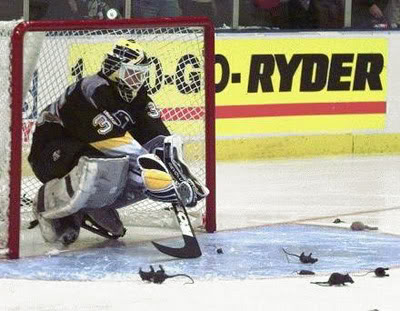
And didn’t fans throw rats onto the ice in Florida more than 15 years ago? The Miami Herald reported earlier this month that with the Panthers’ resurgence, the rats may return to their 1996 glory.

Some players even attempt to get in touch with their inner Nolan Ryan … or their inner Steve Blass.

(Nice frosted tips, JR)

Maybe the Teddy Bear Toss is a little safer?

Yet this ongoing phenomenon could be worse.

What did Bob Froese say after a night in which fans at Madison Square Garden threw plastic beer mugs onto the ice?

“I’m just glad it wasn’t Machete Night.”

The Wisdom of Bryz

When I once asked a defenseman about a goalie who did yoga as part of his training routine, the defenseman shook his head and smirked, then said under his breath, “Goalies are weird, man.”

That’s the stereotype in hockey, right? I mean, you have to have a certain sense of bravery – and insanity – to want to stop a projectile coming at you at speeds about as fast as a slow NASCAR driver. And some of the more notable goalies had their own, ah, habits.

Patrick Roy talked to his goalposts. Ed Belfour became extremely belligerent if anyone touched his equipment. Pelle Lindbergh drank beer between periods.

As evidenced on this season’s first two episodes of HBO’s “24/7: Road to the NHL Winter Classic” – a four-part miniseries that chronicles two NHL teams in the weeks before the Winter Classic – Philadelphia Flyers goalie Ilya Bryzgalov has a glaring idiosyncracy.

He has no filter.

And it’s a good thing.

You tell 'em, Bryz

Rarely do we see candor from athletes anymore. When they’re surrounded by microphones, digital recorders, television cameras and iPhones tethered to webcasts, there’s a certain guardedness to professional athletes. Or celebrities. They don’t want to say or do the wrong thing, for fear of being scrutinized and/or harpooned via the mainstream media, TMZ, Twitter and basement bloggers.

Yet when the HBO cameras are in the general vicinity, it’s different. “24/7” has provided a certain unique window into the lives of NHL players for these past two Decembers – from Max Talbot’s hankering for pretty elves to Bruce Boudreau’s love of Haagen-Dazs.

For two Wednesdays, we’ve been entertained by “The Wisdom of Bryz.”  Last week, Bryzgalov entertained us by explaining what happens in China if you slaughter a tiger and how Philadelphia fans allegedly hated goalies. Oh, and his interpretation of where we stand in the universe:

This week, Bryzgalov discussed in detail his Siberian Husky.

In post-game interviews posted on YouTube, Bryzgalov is composed, a little stiff, yet articulate. He has his moments of clarity, and of falling in line on the record.

Yet from his days with the Ducks, Bryzgalov had it in him. And we are all better for Bryzgalov’s wisdom.

Could Bryzgalov’s wisdom just be something lost in translation? Or is this the goalie’s proverbial 15 minutes?

Better yet, is this how Bryzgalov inadvertently breaks through in another effort to help the NHL continue to appeal to the mainstream? (Secretly, the higher-ups at 1251 Avenue of the Americas ARE LOVING THIS.)

You know goalies. They’re weird sometimes. And that’s not a bad thing.

Shut up, Nancy Grace

Does the story of Baby Ayla – the missing toddler from Waterville, Maine – pull at your heartstrings?

Local police are calling her disappearance, reported on Dec. 16, a “missing child case.”

Do you hope the best for the little girl, yet at the same time expect the worst? (It’s a natural defense mechanism, don’t worry – we are entitled to be skeptics to a certain degree.)

Have you read all the news updates? Have you come to your own conclusions? Are you waiting for the case to continue to unfold?

And have you turned on Nancy Grace? She has made “Baby Ayla” her new cause celebre du jour this holiday season.

(Do you tune in to Nancy Grace? If so, why? If not, why not?)

But is Nancy Grace a champion of the missing, the abducted or the people whose voices have been stifled by some sort of injustice in the world?

Or is she just a fan of hearing her own voice being amplified over the cable airwaves?

Nancy Grace is debasing and selling out our ability to be sympathetic. In the world of Nancy Grace, every baby or female is “snatched” from a comfortable surrounding. Families are complicit in a crime in some way or another – and are talked down to by Nancy Grace for not being vigilant enough or protective enough.

And with every case, she wants the input and information from the local media.

At a local news organization in Maine, reporters were asked to speak about the Baby Ayla case on the air with Nancy Grace. No, correct that. Reporters in Maine have been pestered incessantly by her producers.

One reporter declined the invitation. Another even said something along the lines of, “I’ve got better things to do with my time.”

Is it worth a superficial career boost to be voiced over, talked down to and interrupted by Nancy Grace or any of her bombastic ilk? When, as a reporter, you’ve got a job to do?

And to anyone tuned in to Nancy Grace or Jane Velez-Mitchell’s interpretation and skewering of this case (or any others, for that matter), consider this. It might be best to spend less of your time being fed probabilities, theories, conjecture – all of which further disorient the truth of the matter – and spend more of your time adjusting your filter, deciding what’s real and evidentiary instead of what is driven and sensationalized in an effort to appeal as a low and common denominator.

Concentrate on the facts instead of relying on the rhetoric. Sometimes, as Nancy Grace shows us, it’s just too damn loud.

Tie me up …

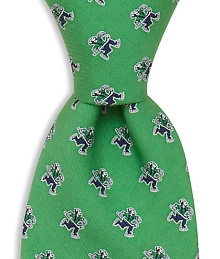
Chances are, “True Prep” will approve of this: vineyard vines, a 13-year-old company based in Stamford, Conn., (yes, its company name is lowercased) announced this week that it has signed a licensing agreement with the NHL, and will create a line of ties, tote bags and belts using the theme of current NHL teams and former NHL teams – including the Hartford Whalers.

And you and I know about the appeal of the Whalers.

Ties, anyone? Samples from vineyard vines’ NHL collection: http://www.vineyardvines.com/category__39614_39614_____13050

But there’s a certain amount of sports-meets-pop-culture in the collaboration between the Stamford, Conn.-based business and the NHL.

“True Prep,” circa 2010, profiled vineyard vines on page 92. The company began after brothers Shep and Ian Murray, disenchanted with corporate life in New York City, took to selling their ties out of their Jeep in Martha’s Vineyard.

Hanging with them at their Stamford headquarters or over lunch in downtown Greenwich, you think: They are two brothers who grew up on your block, or were a grade ahead or behind you in school, or rode the same bus, took the same tennis clinic, or played on your brother’s hockey team. They are familiar …

“True Prep” is the updated version of “The Original Preppy Handbook.” Written in 1980 by a quartet of writers, it’s a tongue-in-cheek cultural study of “prepdom.” Think Ralph Lauren polo shirts, madras, Docksider shoes, BMWs, prep schools in Connecticut, something kind of Kennedy or Crowninshield …

(Note to readers: Take the book with a grain of salt. Even if you are a true prep.)

In writing about “True Prep,” NPR’s J.J. Sutherland has a great analysis of and harkened back to “The Official Preppy Handbook”:

To me it was a catalog of things I did not have and people I wish I could become.

Spencer Bailey – a professed preppy – explained “True Prep” in a Daily Beast piece as a guide to the proliferation of the preppy culture, one I thought was only confined to my high school:

I discovered a culture far more widespread—and diverse—than I ever imagined. In the 21st century, prepsterdom is pervasive.

Yes, even I own a pair of madras shorts and have shopped at trunk shows. (The madras shorts match my faded Tulane Law baseball cap. And can you beat a designer’s trunk show?) If I lost my BlackBerry, I would be lost. As page 86 in “True Prep” explained it: “My whole life is in it.” And back in the day, I even dated a guy from the Gilman School.

These days, I might even buy a vineyard vines NHL tie for my husband. But at $75 dollars a tie, it begs one question … what would Sean Avery do?

Monday morning funnies

Yeah, because I needed a post-NFL Sunday laugh …

Via Deadspin, St. Louis Rams offensive lineman Harvey Dahl had something to say about a penalty …

I don’t know what’s funnier. The lineman cussing at the ref … the TV announcers apologizing … the ref calling an unsportsmanlike conduct penalty for “disrespect for the intended official” … or that the Rams face first and 30.

It’s like the Anti-Tebow …

So a friend of mine in Southern California lost power yesterday, and she lives in the San Diego Chargers viewing area. But, she explained, the power came on just in time for her to watch the Chargers beat the Baltimore Ravens.

Definitely gives new meaning to “Super Chargers.”

And, hey. At least James Harrison has a sense of humor.

Home for the holidays

After careful consideration, I’ve decided I’m going to enjoy the holidays this year.

Did you ever notice that as you get older, the holidays become more stressful? And, frankly, I can’t think of a non-stressful Christmas holiday since …

In college, there was the year I got into a car accident. That was the year after my mother and I argued the entire Christmas break.

Then, I got into the workforce.

There was the year my brother called my parents, who were visiting in Colorado, and chewed my mother out for no good reason, other than for him to serve the purpose of being a holiday-ruiner and life-ruiner.

There was the year a coworker decided he wanted to make my life hell (at the urging of another coworker), at the same time I was considering taking a job in another part of the country.

There were several years I was called into commission to write a story – including two years in which I worked Christmas Eve. One year, I did it because a coworker “didn’t feel like coming into work” that day. Another year was because a story broke on my beat that afternoon, and I had a laptop and a phone with me. (Those aren’t complaints – it’s part and parcel of journalism.)

But after interviewing for a job out West last month – a job that I did not get – I thought for a bit about what I would have to do at one of the busiest and more stressful times of the year. It would mean packing up and moving my entire house, or at least some of it. It would mean driving across the country and leaving my husband. It would mean searching for a new place to live.

In addition to spending money on Christmas presents, preparing to host family and friends, visiting with family and friends …

It would mean not being able to fully enjoy a holiday for another year.

And away he goes …

Charlie Coyle didn’t want to be a college hockey player anymore. And Friday, both Boston University and Saint John of the QMJHL confirmed this: Coyle, a sophomore center, is leaving school to play major-junior hockey in Canada. Coyle leaves the Terriers after 16 games this season, in which he scored three goals and 11 assists and was a plus-7.

(Coyle is also the second departure from the BU hockey team in two weeks, as Corey Trivino was dismissed last week, stemming from his arrest after an incident in which he allegedly broke into a female student’s dorm room and assaulted her.)

Some would be alarmed by yet another player leaving NCAA hockey for the major-junior proving grounds, given a trend that spiked about a year and a half ago: players committed to or playing for college hockey programs, then leaving after a certain amount of time with the program (or even not practicing with the team at all, leaving after making a commitment and before the first practices) for a non-academic-centered hockey program, such as junior hockey or the NHL.

The biggest point of contention in this trend? Players who renege on college commitments to join a major-junior team, or to turn pro instead of exploring their options as a student-athlete. It’s part of the reason why College Hockey, Inc. was established. (Disclosure: I have done freelance writing for College Hockey, Inc.)

College Hockey, Inc. isn’t going to keep college hockey players in college. But it’s a marketing organization to continue to raise college hockey’s profile, and it gives players and their families the proper information on the option of playing NCAA hockey, one of the many options players may have in regards to their future in playing hockey.

But to stay, to depart or to not go at all? It’s like my father used to tell me: No one is forcing you to stay. Or leave. Or not go at all. You have a choice.

***

When he’s asked, a player’s reasoning for his departure in this situation typically goes something like this (if he says anything at all):

“I wanted to develop my game in order to have a better shot at the NHL.”

And that’s a fair assessment. Though there’s something to be said for the virtue of not only making a commitment, but fully honoring it. With our culture shifting towards favoring short-attention spans and instant gratification, will a pattern continue?

And in the wake of these departures, there’s a question: How much of this departure had to do with academic issues?

Coyle said this much via text message to the Daily Free Press, Boston University’s student newspaper:

“Yes, I have made my decision to leave BU because I’m done with being a student-athlete and I want to focus on just hockey  I was not failing out.

“It was definitely a hard decision to make and I will miss my teammates and coaches. BU was a great place to be and I enjoyed my time there.”

In addition, Coyle’s agents emailed a statement to the Minneapolis Star-Tribune, saying that “Charlie Coyle has decided to leave Boston University. Contrary to
speculation he did not flunk out of BU.”

But has anyone truthfully answered this question?

Or have federal guidelines – FERPA, also known as the Buckley Amendment – stifled the response to this question? Or stifled someone from asking the question?

One of the Buckley Amendment’s provisions states that a student must give a school permission to release academic records. It also limits what information an educational employee can release about a student’s attendance, behavior or enrollment.

And has anyone answered this question? Was it solely your decision to go this route, or was it the decision of the NHL team that holds your rights?

Coyle is a former first-round draft pick of San Jose, and is currently property of the Minnesota Wild.

This one’s for you, my friend

So I told a less-than-glowing story about bullying earlier this week, and I hope it inspired someone to stand up for themselves. Likewise, I hope it caused a few bullies out there in the world to consider their past actions.

But today, let me share the story of one of my dearest friends – who, at one point, sometimes made me her target of ridicule. I wasn’t very nice to her, either. It took years and distance for us to see our differences and realize that we were both wrong, on some level or another.

When you read about the aftermath of bullying – some of it has been tragic, such as the suicide of Phoebe Prince or that of Jamey Rodemeyer (Yale University studies have found that victims of bullying are up to nine times more likely to consider suicide than non-victims) – you have to wonder if there is closure. There is, for some.

I had known her since the first grade and we didn’t treat each other very well. In the fifth grade, I had enough of her crap, and the crap of the three girls who always stood behind her when she approached me. I told her so. She slowly began to create distance from me after that, and we both gave each other a certain amount of respect – something you don’t see often among pre-teenagers or teenagers.

Then, in the ninth grade, she and her family moved across the country. And I was sad to see her go. Someone who I knew for nine years but whom I did not know well enough to call a friend at the time. Still, I would miss seeing her in the halls every day. She was one of a small (and getting-smaller) group of us who began elementary school together, and with whom I expected to graduate from high school.

Nearly 20 years later, here’s that Facebook thing again – we had enough mutual friends that she came up in the “friends you may know” category. That pesky Facebook …

I don’t remember who reached out to whom, but at first, I was conflicted about it. Still, I gave her the benefit of the doubt and told her, “Things weren’t the same at our school after you left, and I always wondered what you were doing.”

A funny thing happened. She admitted to me years later that she moved away and that she had found out who she really was. And she apologized to me. And I apologized to her. I told her, “I forgive you.” Because I did.

Today, I call the person who used to antagonize me “my friend.” I look forward to every email, text message and funny card I receive from her. In fact, she sent me an email this morning and I read it over coffee, wishing she and I (and her baby son and husband) could have coffee together soon. I am honored to be able to learn about her and to be able to share my life with her. She  is an intelligent, caring, funny, inquisitive and loving mother, woman and friend.

***

From a TeenHelp.org forum, the honesty of a former bully:

I will not deny it – people have a right to know what I have done…how cruel I have been to someone who absolutely did not deserve this and how many times I have hurt him so deeply that he will possibly never fully get over it although I would now do anything for him he wants to make atonement – but I know even that will never be enough. I endlessly regret it now and I will for the rest of my life mourn it and feel absolutely sorry. I blame no-one who despises me because of what I have done or wishes that I will never again be happy in my life or that something really bad will happen to me. I cannot blame anyone because I actually despise and hate myself because of it.

There was NO reason, justification or excuse for bullying someone in the ways I did – there never is. All I can say is that I tried and am still trying so very hard to repair at least a part of the damage and suffering that I have caused.

A high-octane exit

Remember this?

And this?

This, too?

Erase most of those images and words from your memory. No, not that last one. It’ll serve as a painful reminder of Todd Graham’s short, um, legacy at Pitt.

Today, Graham notified his team – via text message – that he was leaving Pitt and heading to Arizona State to become its next head football coach. Yes, he’s leaving on a jet plane … 

And Pitt sent out the release on Graham’s departure this afternoon, stating that “his decision was based solely on personal family reasons” – and that his resignation came after Pitt athletic director Steve Pederson denied Graham permission Tuesday night “to speak to another institution.”

“This is the first job I’ve ever taken that’s benefited my wife,” Graham said during the Arizona State press conference.

Arizona State officials would not comment on the timeline or the process of their coaching search, citing privacy issues. Later in the press conference, broadcast via the web, Graham said this:

“You never want to leave a program, and I never thought I’d have to leave a program, under these circumstances. … It did not allow me to speak to the team, and I really regret that.”

***

Each time I watched a Pitt football game, I tried to figure out who was more of a fraud:

  • Pitt quarterback Tino Sunseri, who struggled all season to quickly adapt to the “high octane offense”;
  • or his coach, Graham, the purveyor of said offense and Pitt’s second choice as this year’s head coach. (What did Chris Rock say in “Never Scared”? “‘Cause you ain’t her first choice!”)

This afternoon brought about the answer:

Yes, Blair Philbrick, Pitt’s assistant athletic director/football operations, forwarded Graham’s text-messaged/emailed statement to his players regarding Graham’s departure, per the Pittsburgh Post-Gazette.

“I reached out he only way I knew how,” Graham said during tonight’s press conference. “The only other alternative I had was to not communicate at all.”

Yet today proved that Pitt’s quarterback, to a certain degree, was simply a pawn. That Graham ultimately was in search of his fourth greener pasture in less than six years. While you can’t hold someone down from chasing their dreams, you have the right to question how they did it if it appears at all scurrilous.

Still, Graham’s departure – less than a month before the BBVA Compass Bowl in Birmingham, Ala., Pitt’s second appearance in the bowl in as many years (and second without a permanent head football coach) – reiterates a certain truth about college athletics: That while there are some exceptions, college coaches tend to be about as virtuous as a case of cheap beer. They won’t trust you, but you will put all your faith in them … until they leave you with nothing but an empty, painful feeling after you drank it all in.

Remember Roy Williams’ infamous declaration after the 2003 NCAA basketball championship game that, “I don’t give a @&*^ about Carolina right now …” ? Or Alabama Coach Nick Saban, then at Louisiana State, declaring ‎that “Anyone who doesn’t win their conference has no business playing in the national championship game.” (He’s not saying much about that now, is he?)

Insert sarcasm font here: There was so much virtue in those statements, wasn’t there?

No wonder some of us, as sports fans, struggle with some truths.

But Pitt fans, did you trust Todd Graham? Did you have any faith that the system – an offensive line that has allowed a Big East-high 56 sacks, an offense that is seventh (of eight teams) on third- and fourth-down conversions, and a team that leads the Big East in penalties – would pay dividends? Did you believe that with Graham, there would be better days ahead at Pitt?

There still might be. Just without Graham. As for Sunseri? He said this: