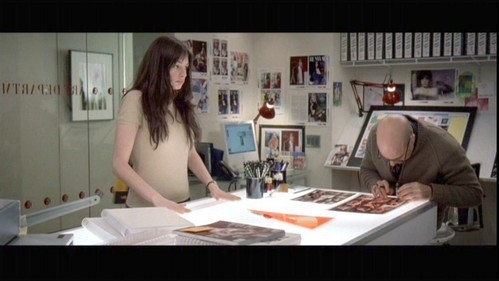
Aloha

As I watched the movie “Aloha” last night, I could only think one thing: This would make a much better book than a movie.

In a nutshell (thank you, Google):

While on assignment in Oahu, Hawaii, military contractor Brian Gilcrest (Bradley Cooper) reconnects with his old flame Tracy Woodside (Rachel McAdams), now married to an Air Force recruit (John Krasinski). He also spends time with Allison Ng (Emma Stone), a hard-nosed fighter pilot who watches every move that he makes. As they travel throughout the lush terrain, Brian finds himself falling for his feisty guide, while his conversations with Tracy may provide a shocking revelation from their past.

The Cameron Crowe movie got a really bad rap, in part because of the issue of casting Emma Stone as Allison Ng – a white woman playing a woman of Hawaiian and Chinese descent.

The movie was also largely panned by critics. Variety called it Cameron Crowe’s “worst movie yet.” The New York Times said it was a “disappointment,” but “a loose, leisurely hangout movie, funny and sprawling and full of eccentric, interesting folks.”

However, the controversy surrounding the movie, which was largely panned by critics, made me curious. I still wanted to see it. As I watched the movie, all I thought was, “this would make such a good book!” There were so many layers to the story:

  • relationships between men and women, one of my favorite subjects in fiction
  • space exploration – especially because it’s becoming privatized
  • Allison Ng, herself, is a captivating character – a captain in the Air Force who flies jets and who understands the depth of the Hawaiian culture
  • making choices not just to appease others, but to remain true to yourself
  • How relationships and connections endure – in ways you really have no idea

The soundtrack, btw, is fantastic.

But can someone make this into a book, pronto?

23 years ago this weekend …

Sunday is the 23rd anniversary of one of the saddest and funniest memories I have from high school.

The phone rang as we were eating lunch in the house I grew up in. Bacon, eggs and toast. I was still in my pajamas, still relishing the idea of a lazy Sunday afternoon in my room, watching hockey or reading.

Our family’s rule was that nobody was to answer the phone while we were at the table during a meal, but I leaped to pick up the receiver. For some reason, I knew this noon-hour phone call wasn’t going to be a good one.

“Rachel,” a desperate, sad voice said on the other line. “Rachel. I got into an accident.”

“Oh, no.” I said. “Brian. Brian.”

My family looked at me from around the table. My father shook his head. My brother smirked and chuckled. My mother motioned for me to get off the phone. I don’t know what the look on my face said, but it must not have been good.

A mutual friend of ours – who, it ends up, was an awful driver, as this was the second of three crashes he was involved in – rear-ended the back of Brian’s new car, crumpling it. Brian and I went over to the house where the car was stopped, and it was just a mess. Even messier was the battle between the parents, who tried to pass blame from one person to another.

I had just met the boy of my dreams, a hockey player from St. Mary’s who had nothing to do with our group. Brian and I had cruised around in his Acura the previous morning, presumably to show off to Kristina, the girl he was in love with. I had gone out the night before, cruising around Annapolis with two of my friends.

Life was pretty fantastic for a 16-year-old. Until someone crashed into the back of my friend’s car.

And when I saw that Brian’s birthday was coming up this weekend, I couldn’t help but to burst into laughter and think of that teenage disaster. I would think that all of us have become better drivers since then.


On the Patrick Kane saga, and what we can take from it

The Erie County (N.Y.) District Attorney announced today that it will not seek charges against Patrick Kane regarding a rape/sexual assault allegation stemming from an incident at his home in August. So Patrick Kane can go play for the Chicago Blackhawks with his clear conscience, right?
The Hockey News wrote a big post about “what we learned” from the Patrick Kane saga and went on and on about “rush to judgment” and “rape kits are in boxes and not bags” – now that’s just a poor attempt at humor with a perpetuation of rape culture – and how a “case” was rife with reasonable doubt?
How about the other side of it? How about a few more lessons we can learn away from the courtroom or the media regarding such a high-profile saga involving one of the NHL’s mega-stars?
How about teaching men and women that consent – or lack thereof – is not implied but must be determined?
How about men and women making smart decisions about themselves and about their personal and sexual safety?
And that Patrick Kane needs to learn to respect women. And people, for that matter.

One more thing to tell people about being a journalist

lenziclass
Talking to Jeremy’s class at Greensburg Salem High School, Oct. 23, 2015 – Greensburg, Pa.

So I’ve been speaking to a lot of high school and college students lately about the craft of journalism and how it crosses all platforms. I’ve stood up in front of classes, I’ve Skyped with students, instructors and professors, I’ve even talked on the phone with people working on papers and projects, and I’ve discussed how the industry has changed.

In 1998, I was only writing for a daily newspaper, and I was responsible for one, maybe two stories a day. Now I’m blogging, tweeting, making videos with my iPhone and sending up-to-the-minute online updates on a major Division I college football program.

I’ve also discussed what it’s like to be a women in a male-dominated field. How important it is to hold onto the fundamentals of journalism, but also discussing the importance of being knowledgeable of what you cover, the importance of working hard and working smart, and even the importance of how you professionally present yourself.

I’ve thought of a few constants that still hold true, 17 years later, but this afternoon I thought of one more thing I wish I could have impressed upon students.

Thanks to the greatness of multimedia, it’s not too late to do it.

Here’s one piece of advice: find a niche – and treat it like the most important thing that will go onto your platform. Because someone else out there is interested in it, too.

I did it with high school wrestling in Colorado.

I did it with high school hockey in Maine.

I did it with the University of Maine hockey team – which WAS a big deal.

I still do it with Michigan football – which IS a big deal.

Find something you are passionate about covering and learning about. I’ve seen some really, really incredible journalists do this, and soar because of it.

By doing this, people will see that you care. And they will respond.

Please, don’t ever let Norwood Teague back in college athletics

Norwood Teague should never be allowed to work in college athletics again. Or in higher education.

It doesn’t matter if it’s at another Big Ten Conference school, another Power Five school, a mid-major or at your daughter’s junior high school. Norwood Teague betrayed the trust and respect of his school, his colleagues, his family and the people who know him. And he gave us more justification as to why we shouldn’t place much faith in our own leaders.

The gravity of what Norwood Teague did – sexually harass female employees as the athletic director at the University of Minnesota, and resign once his behavior came to light – was apparent before. It suddenly carried an even greater weight when Amelia Rayno, a Minnesota basketball beat reporter at the Minneapolis Star Tribune, went public Sunday night with a detailed account regarding her interactions with Teague over the course of nearly a year.

Those interactions were unprofessional, unsavory, hypersexualized and an example of a man who had no control of himself – and who needs some serious professional help before he can even consider resuming his career in college athletics.

This is not how a top administrator at a major university should represent himself. Or should interact with women. Instead of treating Rayno with the professional respect she deserves, he followed his own impulses and cast fear on her job. And probably, to a certain degree, on her life. And I guarantee you that she is not the only one this has happened to, and that Norwood Teague isn’t the only one who has crossed the line into dangerous territory.

Some disclosure: I know Amelia, and I have worked in press boxes and on media row with her. She is a hard-working, respected reporter who is passionate about her job and about her beat. As we all should be in this business.

Maybe I am writing this simply because I am the token female in my sports department, but in 18 years of working in sports journalism, I am familiar with a hard truth about the jock culture. The hard truth that people don’t want to accept about the jock culture is that women are always valued more as one-dimensional currency and less as multi-faceted brokers.

And I know this: I feel a strong empathy with anyone who has to go through this, regardless of what they do for a living. And I know a universal truth, not just in sports or in journalism: this happens a lot more than we know.

But we can do something about it.

If this happens to you, go to your bosses. Go to a trusted advisor. If you’re a sports reporter, reach out to the Association for Women in Sports Media. As a member of AWSM’s board, I ask anyone in our industry – man or woman – that if you encounter this same problem, please reach out to us. Ask us for guidance. Utilize us as a resource. This is one of the many reasons why we’re here. Don’t sit in silence and simply hope the repulsive behavior stops. You’re probably not the only one going through this.

We have the right to set boundaries for ourselves. To know and exercise consent. To emphasize personal responsibility. Not just for ourselves but for the people whom we hold accountable as fellow human beings. And no one has the right to abuse their own power, or the liberties that they believe we give them because of that power.

Norwood Teague took liberties. Too many of them. Against his employees and the people who hold him accountable. Power and prestige are simply no justification for repulsive behavior. And no amount of power or prestige gives anyone the right to behave like a deviant – or to continue to support someone who does.

Another coach shown the door

I did not know Linda Kilpatrick personally and was never coached by her, but I had coaches like her when I played high school sports – Phoebe Kelly, Bruce Villwock and Lil Shelton come to mind.

Coach Kelly was tough, but she was fair – values that I carry today. She also had no qualms about telling me when I screwed up or needed to get my act together. One time she noticed that I was upset about something – something 21 years ago that now seems trivial – but she took me into her office and gave me some great advice. “Kiddo, things don’t always go as planned. You have to grieve, but you have to get used to it and figure out something else.”

Coach Villwock was similar. Tough but fair, but a person who as a teacher, always wanted each of his students or his athletes to find the best in themselves, even if they weren’t the best athlete or the best singer or the best student.

Coach Shelton coached at our rival high school but each summer held a field hockey league at a minimal cost that brought girls together from all over the county as a way to teach the sport (and maybe to scout her school’s rivals), but she was able to identify talent and encourage it.

People like Coach Kelly, Coach Shelton and Coach Kilpatrick in particular opened the doors for many female athletes in Anne Arundel County, not just because of their ability to influence people but also because they were among the first beneficiaries of Title IX – a federal law that helped pave the way not only for sanctioned girls and women’s sports but also for many of the educational opportunities that women have today. Anne Arundel County administrators need to be smart enough and cognizant of the fact that by pushing out older coaches, they are cutting off a valuable lifeline.

From reading my hometown paper, Kilpatrick was shown the door by an administrator who decided the women’s basketball program at Southern needed to go in a different direction. My father sent me a message that “if you knew Kevin Hamlin, you’d understand.” Hamlin, Southern’s principal, is likely looking at this from a cost-analysis perspective. Or the fact that Southern went 2-22 this season. Or maybe he and a few angry parents simply had a beef with Kilpatrick and chose to railroad her, instead. (It’s happened at other schools in other states. Heck, it happened at my high school in 1991. So this is nothing new.)

This is also indicative of the state of our educational system – are some administrators are intent on producing widgets and prescribing to the dreaded “Common Core” instead of encouraging students to be thinkers and doers, and to question things? Yet what buoys me in reading this article in the Capital is the incredible response of the Southern student body, her former players and female coaches – an example of what kind of impact that a teacher or a coach like Kilpatrick made upon them.

In professional sports, coaches are expendable. They are hired to be fired and can easily be replaced within a small window, usually by a costly recruiting firm. High school coaches – many of whom are teachers or administrators themselves – are not.

I’m sorry I never said a proper goodbye

One day in 1984, I was sitting at the kitchen table of my friend’s house, eating breakfast that had been prepared by our babysitter. Mom and Dad dropped me off at 7:30 in the morning at the house where we spent much of our summer.

As I finished a bowl of cereal, my friend Mike came down the stairs from his bedroom wiping sleep from his eyes. He was covered in scratches.

“What happened?” I asked. “Did you get into a fight? Did you fall from a tree?”

Before Mike could answer, his younger sister chimed in.

“Mike and Shane tried to put our cat in the kiddie pool. Three times!”

That’s how I found out cats and water didn’t mix, thanks to Mike.

But that was Mike. Mischievous, a bit manic and absolutely hilarious. Here’s an example: At dusk, Mike and his friends would ride their bikes around the neighborhood, armed with a garage door opener, clicking as they drove by houses and laughing as they watched a garage door go up.

Mike had a good heart that had been bruised and broken before he was old enough to know how to handle it.

I found out this week that Mike recently died. We hadn’t spoken since high school; he was a year ahead of me and I had been dismayed by his behavior during his senior year, over a family incident that I didn’t find out about until years later. As much as I wished I could have helped him, I knew better – that it would not have been my place, that Mike was struggling with how to handle his own heartache.

But my memories of Mike are mostly good ones.

When Mike was in the fourth grade, he loved Michael Jackson – so much that he had a sequined glove and learned to do the moonwalk. When he tried to teach me how to do it, he told me I was hopeless at it, but called me “Moonwalker” for a few more years afterwards.

Our birthdays were one week apart; our babysitter and our after-school programs always planned joint birthday parties for us. We’d complain to each other and to our friends that we had to share a birthday cake.

In the eighth grade, our French class went to a local restaurant at the end of the school year for what we called a “fancy dinner.” As we waited for our parents to pick up us and our classmates, Mike and I had a quiet moment together. He looked at me and said, “You know I always liked you, right?”

To an awkward eighth-grader, this was akin to landing your first job. Even though it never happened with Mike and I, other than some kissing and a 14-year-old’s attempt at a grope, what he told me made my confidence soar. He was a sex-obsessed little ninth grader but the following year, we ran into each other after a spring practice and talked in the middle of the driveway in front of our school. We hugged. It was strangely sweet.

Years later, I was listening to a CD in the rec room with his younger sister and her two best friends, when Mike and one of his friends came charging down the stairs of their house. Mike stopped and grinned sheepishly at us. I thought for sure he was making eyes at one of his sister’s friends. A few weeks later, his sister told me that Mike was hoping to talk to me. A few months later, a teammate of mine read an R-rated note he and a friend had written specifically for her. She thought it was the funniest thing. I told her to throw it away.

Mike left Maryland and found a home out west. He married a woman and had a daughter with her. I’d seen him on Facebook, but was never willing enough to send him a friend request. I always got the feeling that he didn’t want to be associated with that part of his life, all the growing up that took place on the corner of Shore Acres Road and Dunberry Drive.

I don’t know what the circumstances were that surrounded his death. I’m sorry that I never took the chance to reach out to someone who played a significant role in my childhood. I’m sorry I never got a chance to find out the adult that Mike became, or the father or the husband. And I’m sorry I never said a proper goodbye to the person I knew and loved, a person who played a role in my own growing up.

“I can get another girl to take your job in five minutes … one who really wants it.”

andynigel

Andy Sachs: She hates me, Nigel.
Nigel: And that’s my problem because… Oh, wait. No, it’s not my problem.
Andy Sachs: I don’t know what else I can do because if I do something right, it’s unacknowledged. She doesn’t even say thank you. But if I do something wrong, she is vicious.
Nigel: So quit.
Andy Sachs: What?
Nigel: Quit.
Andy Sachs: Quit?
Nigel: I can get another girl to take your job in five minutes… one who really wants it.
Andy Sachs: No, I don’t want to quit. That’s not fair. But, I, you know, I’m just saying that I would just like a little credit… for the fact that I’m killing myself trying.
Nigel: Andy, be serious. You are not trying. You are whining. What is it that you want me to say to you, huh? Do you want me to say, “Poor you. Miranda’s picking on you. Poor you. Poor Andy”? Hmm? Wake up, six. She’s just doing her job. Don’t you know that you are working at the place that published some of the greatest artists of the century? Halston, Lagerfeld, de la Renta. And what they did, what they created was greater than art because you live your life in it. Well, not you, obviously, but some people. You think this is just a magazine, hmm? This is not just a magazine. This is a shining beacon of hope for… oh, I don’t know… let’s say a young boy growing up in Rhode Island with six brothers pretending to go to soccer practice when he was really going to sewing class and reading Runway under the covers at night with a flashlight. You have no idea how many legends have walked these halls. And what’s worse, you don’t care. Because this place, where so many people would die to work you only deign to work. And you want to know why she doesn’t kiss you on the forehead and give you a gold star on your homework at the end of the day. Wake up, sweetheart.

This is probably one of my favorite scenes in “The Devil Wears Prada,” when Andy, the novel’s protagonist, goes to Nigel in tears because Miranda Priestly has yet again stepped on her with the heel of one of her custom Jimmy Choos, without any hestitation. Because Miranda keeps her magazine running.

And because after years of working her way to the top, Miranda Priestly has earned the right to do so.

Every intern or recent college graduate stepping into his or her first job out of college needs to watch this scene, and then needs to shed any sort of entitlement that they have when they join the work force.

Because your workplace does not owe you anything. Even if you decide that you hate your job, your boss, your coworker or coworkers, the town you live in, don’t share that publicly – with your competition or, God forbid, on your social media accounts – because it’s not a reflection of them. It’s a reflection of you. And it will be used against you in a court of public opinion.

It’s all temporary. Just keep in mind that you’re paying your dues and cutting your teeth. Your degree and your alma mater entitles you to nothing. When you take the next step, you’ll appreciate it that much more, knowing what you went through to earn that next opportunity.

But if you really hate it, go ahead and quit. Go back home to Mom and Dad and work at the Gap, or move back to your college town and serve coffee at the Starbucks across from campus.

Besides, the people who took a chance and hired you can probably find somebody to take your job in five minutes … someone who really wants it.


Start making changes

“Maybe we need to hire a female NFL commissioner?”

That’s a great idea that my male friend brought up in the wake of Ray Rice’s indefinite suspension from the NFL, and the league’s botched handling of the case in which video surfaced of Rice punching his wife in a New Jersey hotel elevator … but let’s take it a step further. 

Change begins at the top of the food chain. Not necessarily with a new female commissioner, but NFL organizations (MLB, NHL, and NBA, too) need more female representation within their front offices.

Go into a pro sports facility or even a major college football or basketball facility and where are the women you see? They’re administrative assistants, or maybe a media relations representative, or an athletic trainer. Or maybe a reporter. Or a wife or a daughter of someone on staff. They’re not working in titled positions in front offices with responsibilities such as player personnel, team operations or scouts. And they certainly aren’t coaches.

Is there a Rooney Rule for women? If Baltimore Ravens owner Steve Bisciotti was smart – or if he might possibly have smart people around him (and we might be giving the Ravens too much credit by stating that) – he’d propose its institutionalization. And not just as an olive branch to the women the Ravens and the NFL will have alienated.

There’s still another area that needs to be addressed – consider how pop culture and the media portray women in sports:

Cameron Diaz was a Machiavellian team president in “Any Given Sunday,” – whose quarterback tried to ask her out on a date.

Jennifer Garner was a salary cap expert in “Draft Day” … who secretly carried the general manager’s child.

Annie Savoy. Enough said.

Even on broadcasts, there are few women *in the broadcast booth* – but chances are, they’re tertiary. We can recognize the women on the sidelines, but chances are, more people are interested in their Instagram account and their photo shoots than their knowledge of the post route.

The other day on a Detroit sports talk radio station, the afternoon radio guys wrapped up an interview with a female television personality and after she hung up, one of the first things they said was, “Man, she is hot.”

*This* is how men are identifying women in the industry? And marginalizing them? How do they view the female fan base? 

The botched handling of the Ray Rice saga reminds us that yet again, “le deuxieme sexe” isn’t a priority for the NFL. Unless it involves pink cleats and wristbands in the month of October.

Instead of devoting a month to breast cancer awareness, devote it to domestic violence awareness and sexual assault awareness. Ask a survivor of an abusive husband or a survivor of rape to address an NFL team.

The league has a chance to rectify itself after the Ray Rice situation – and has the chance to become an agent for change.

Sadly, it took a woman being punched in the face for the culture to realize change has to be made.

Click here! Click here!

Sports On Earth has been a corner of the Internet devoted to longform journalism, analysis and the overall cerebral side of sports. But as of this week, it has been gutted, part of a shift by parent company Gannett to separate digital operations from publishing operations.

Meanwhile, SportsGrid.com states its case of the demise of SoE’s, and blames it on the most primal of urges:

It wasn’t like most sports blogs out there — it was a bastion of smart, well-thought out analysis and profiles. That probably played a role in its downfall.

I don’t know the inner workings of Sports on Earth. I don’t know what politics might be going on behind-the-scenes at USA Today. Maybe this was a long time coming for SoE. Maybe it had nothing to do with content and more to do with, I don’t know, cost-cutting, or someone at the company having a bad hair day and taking it out on its most talented and thoughtful publishing arm.

But here’s what I know about sports media, via our little window at SportsGrid: Where were the tits? Where were the asses? Where was the scandal? Because our biggest hits are invariably posts that involve at least one, and hopefully all three, of those themes.

HELLO? PEOPLE LOST JOBS AND LIVELIHOODS.

Poor Hugh Hefner. He’s losing readers to this kind of clickbait. And poor Paulina Gretzky. I fear that more people know her for her Instagram account than they do for all that her father accomplished as a hockey player. Sportsgrid might also remind me of that little gambling snafu Wayne and Ms. Jones got themselves involved in a few years ago. Sex and scandal, right?

But hey, you got me to click. Congratulations. That’s what constitutes “new journalism,” doesn’t it?