Toss that teddy!

It’s the most wonderful time of the year, right?

Hockey rinks across North America pick one night a year that allows a toy to become a projectile. The stuffed animal, a staple of childhood and a talisman of innocence … gets the chance to fly.

After the home team scores the first goal on the designated “Teddy Bear Toss” night, fans launch their stuffed animals into the air and to the ice, one of thousands that will be headed to a better place.

Now there’s no magic that comes into this happening. Instead, it’s a byproduct of a smart marketing department, fans willing to part with their good toys and a collective desire to give to charity – children in need, children in the hospital during the holidays instead of being at home, children without families …

The Teddy Bear Toss isn’t just about the teddies – some of the kids and their families have heartbreaking, yet inspiring stories.

And, frankly, it’s one of the best traditions in hockey.

Please, don’t toss me. No, wait … please do!

The teddy bear toss is popular in Canadian junior hockey as a promotional and charity event, though you probably don’t see the tradition in the NHL for a few reasons including: one, liability issues and two, it takes more time to clean up the toys that are thrown onto the ice than it does to throw them.

But the phenomenon of thousands of flying teddy bears certainly creates a spectacle – and a YouTube sensation.

Last year in Calgary, during a Western Hockey League game, more than 23,000 stuffed animals were tossed to the ice in a span of less than four minutes (per the Calgary Herald). It took nearly 40 minutes – delaying the game – to collect all of the toys and to do ice maintenance. At one point during the toss, benches were cleared and players went to their respective dressing rooms. What else was there to do besides wait?

This year, the fans in Calgary outdid themselves, throwing more than 25,000 stuffed animals to the ice. That’s 25,000 good homes, you know? (via Puck Daddy)

Saturday in Hershey, the Bears fans made it rain. Jason Chaimovich, vice president of communications for the American Hockey League, sent this video across via his Twitter account. (@jchaimo)

And this one in Kamloops, B.C., from HockeyProspect.tv, via Jerome Berube, a producer for the site. (@Jerome_Berube) There aren’t a lot of bears as compared to Calgary, but the WHL play-by-play guy dresses it up with the call.

Now, with this time of the year, the updates of hockey arenas having teddy bear tosses are coming across Twitter … and there are no accompanying visuals. It’s like ordering a bloody mary … and getting a sad concoction of tomato juice, Red Hot sauce and cheap vodka. No kick, no power, no oomph.

Scribes, fans, PR peeps, I implore you – post the hell out of the teddy bear toss. Videos, photos, testimonials, befuddled teddy bears. And if you can, give it this hashtag: #teddybeartoss

Besides, what kid doesn’t love a teddy bear? Or 25,000 of them?

You are what you wear.

Leggings.

I despise leggings. I despise leggings even more when leggings are not worn appropriately by women – when they are worn as pants, in lieu of pants. And worn to work.

Because the world does not need to see the crease in your butt, the lines of your panties or the folds of your nether regions. Not sexy. And not appropriate for the work place.

And guys, you’re complicit in this, too. Like when you show up in a t-shirt, busted cargo shorts and ratty flip-flops to the job, feeling comfortable but looking like you just came in from an afternoon keg party instead of preparing for your next assignment.

So when you show up to work dressed like you’re going to the gym, a frat party or to a sleepover, your credibility diminishes. It sends a message: Are you at all serious about work? Do you want others to take you seriously? Are you more interested in picking up men by wearing tight clothing than completing the task that puts money in your wallet? Would you rather be comfortable in busted cargo shorts than be credible in a button-down and khakis?

What ever happened to the dress code, anyways?

It’s not worth the energy to tell you what to wear and what not to wear. But keep this in mind:

Presentation is important.

The cannibalization continues

A handful of employees at the Colorado Springs Gazette won’t be going back to work on Monday. And this saddens me.

http://www.gazette.com/news/gazette-129494-first-put.html

I just gotta know …

Will the online component carry the weight – and the clout – that print journalism is losing?

And, more importantly, how does the Colorado Springs Gazette – or any paper that’s making cuts to the newsroom – expect to “deeply connect with the readers,” let alone forge a connection with the readers … when you cut the people who go out and work with and among the readers? When there is no one left to engage with readers? How will electronic connections forge relationships in the community, in lieu of initial and continued face-to-face communication?

Newspapers are being cannibalized. Their employees are being eaten alive in an effort to keep others alive and in an attempt to reinvent the product.

Via a friend of mine, the American Journalism Review recently ran a story about newspaper downsizing and the lack of transparency that comes with it. But it also hit on a point. What is one of the effects of staff reductions? Ken Doctor, a news analyst who runs the website Newsonomics.com, asks this:

“How many [important] stories never see the light of day?” Doctor asked. “How many corruptions, large and small, are unfound? We don’t know; we don’t know what we don’t know.

***

What is happening has forced me to ask some introspective questions about people like myself, who won’t be going back to work on Monday. Two instances brought these questions up: earlier this week I read about buyouts at the Denver Post, including theater critic John Moore, who wrote a poignant piece about his departure. Then, as I sat down Friday night to watch Denver-Colorado College hockey, a tweet came across my timeline – the aforementioned layoffs at the Colorado Springs Gazette. Layoffs that included the once-great paper’s college hockey writer. (Notice that the Gazette’s story didn’t include the mention or the number of people who lost their jobs – but the comments, some written by former Gazetteers, did.)

Are we casualties? Are we statistics? Are we martyrs? Or are we on the verge of something new, on the cusp of reinventing ourselves? Nothing seems to get better in the newspaper industry, and the number of supposed casualties continues to mount. Some of my peers believe they’re working on a sinking ship, some of my older counterparts are watching inept management run their papers into the ground. Others talk about how close their workplace was to bankruptcy – one newspaper couldn’t even order basic office supplies without approval of the CFO. (Journos, do you know who your outlet’s CFO is?)

In light of this, I think of Alfred, Lord Tennyson’s poem, “The Charge of The Light Brigade.”

In the movie “The Blind Side,” Michael Oher asked this as the poem was read to him:  “Someone made a mistake? … But why would they go ahead if they knew he messed up?”

Theirs not to make reply,
Theirs not to reason why,
Theirs but to do and die.
Into the valley of Death

Rode the six hundred.

So people are getting out. Some of us, not by choice. The stories continue. The questions continue to be asked. With each goodbye, I am saddened. Yet at the same time I am enlightened. I am buoyed by the strength and the spirit of each person who has gone through this. Each of you inspires me.

Sing it, Rob

I never saw Rob Bellamy play hockey at the University of Maine – his last year in Orono was my last year covering high school sports.

But last spring, one of Bellamy’s videos landed in my inbox – his cover of Ray Lamontagne’s “Trouble.” As I watched the video at my desk, I thought of something – in general, we don’t really know much about the athletes we cover, watch or read about. There’s a defined line between being friendly with someone and being friends. No, let me rephrase that. If you’re a reporter in any medium, there’s a very defined line between asking questions and getting to know a subject personally. Most of the time, you can’t cross it. And in the same light, your subject probably doesn’t want to cross it.

Yet in showing his music to the world, Bellamy put his passion out there. It’s not an easy thing to do, to open yourself up to others, to their opinions and, potentially, to scrutiny.

http://www.pressherald.com/sports/whole-new-gig-on-the-horizon-for-rob-bellamy_2011-05-16.html

Working on and writing this story brought up another issue – a coworker asked another coworker about this story, “Why is this important? Why is this even in the paper?” (The newsroom is a strange incubator – someone else’s words will almost always get back to you.)

If you’re a reporter, there’s something to be said for generating offbeat, unique stories, ideas that come from “outside the box.” And at newspapers, even with the online component becoming crucial in the news cycle, these kinds of stories are diminishing – smaller sections, smaller staffs, smaller budgets, smaller windows of time to do quality work …

Likewise, the media and the fans make athletes very one-dimensional – and athletes sometimes don’t make themselves multi-dimensional, maybe out of defense for themselves. When it seems like everyone wants a piece of you, you don’t want to give away a lot about your true self.

Besides, isn’t music a universal thing?

At Maine, Bellamy was a fearless right wing known for his aggressive style of play. But away from Alfond Arena he listened to music and thought about how he would write a song about his own personal experiences. Sometimes he recorded videos of himself playing the guitar and posted them on YouTube — videos he later took down. He’d sing for his friends and family, who encouraged him to pursue music. “I didn’t take it serious, though,” Bellamy said. “I had a lot of work to do. But I kept practicing and practicing, and I started playing in front of more people. People kept saying the same thing, and I thought, ‘Maybe they’re right.’ “

On Dale Hunter, or why you can’t have it both ways

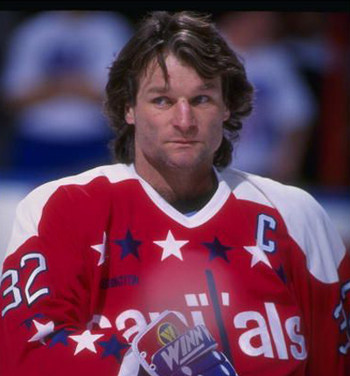
My name is Rachel, and I’m a Dale Hunter fan.

There. I admitted the problem. That’s the first step in the road to recovery, isn’t it?

Though I grew up in Maryland, I’m not a Washington Capitals fan. I like to joke that I was one of the thousand or so who knew the DC area had an NHL team before 2006. (And, yes, I own a Geoff Courtnall Capitals jersey, circa 1989.)

But Dale Hunter carved his place in Washington sports in the time he spent with the Capitals, playing in Landover and then in the District. Among his NHL stats? 1,020 points and 3,565 penalty minutes in 1,407 games with the Quebec Nordiques, the Capitals and the Colorado Avalanche.

And I knew that watching all those hockey games on Home Team Sports and SportsChannel America, in lieu of doing homework, would pay off somehow …

One of the more unique moments of my tenure at my former paper was when I got to interview Dale Hunter’s son, Dylan, who played for the AHL’s Portland Pirates during the 2008-2009 season, as I was working on a story on faceoff specialists in hockey.

A week earlier I’d met the son of Caps commentator Craig Laughlin, who assigned me a task. When I met Dylan Hunter it was less of an interview and more along the lines of this: “Dylan, I’m under strict orders from Kyle Laughlin to tell you he says hello. And I remember you running around Piney Orchard when you were about six years old.”

He was stunned that this random woman he’d just met would bring up pieces of his past. And we talked less about faceoffs and more about the time he spent living in Maryland, about six or seven miles from where I grew up, and the people we had in common. We talked about John Tavares, who was on his way to becoming the NHL’s No. 1 draft pick that year – a player whom Hunter regarded as one of the best faceoff specialists he’d seen to that point in the time he’d played hockey.

Then, Hunter told me what his father, Dale, told him when he was struggling to win faceoffs. And it gave a little insight into how Dale Hunter thought as a hockey player.

“Watch the official’s hand right before the draw,” Dylan Hunter recalled his father telling him. “Don’t watch the puck. Watch the hands.”

Dale Hunter was the face of all those Washington Capitals teams in the 1990s. If Rod Langway was the Secretary of Defense, the mainstay on the blueline, the Dale Hunter led the special ops. Hunter played with a hardened edge. He was a player who wasn’t afraid to mix things up, a renegade of sorts, both overt and covert. And he was an NHL pest before it being an NHL pest was in vogue.

TSN named Hunter one of the NHL’s 10 most hated players – No. 7, in fact. And he will probably never be absolved of one of the league’s more dubious moments in the 1990s – his hit on Pierre Turgeon during the 1993 playoffs. And from the outside, that may become part of the definition of his NHL legacy.

Yet, at the risk of sounding beyond creepy, if you looked into his eyes, an intense, almost scary competitive fire burned in them. Heck, after reading and watching all the coverage of his first few days on the job, that fire still burns in them.

But here’s the catch – and the basis of my admission. Not only am I a Dale Hunter fan … but I’m also a Pittsburgh Penguins fan. Something’s got to give, right?

A Mess with a Capital “M”

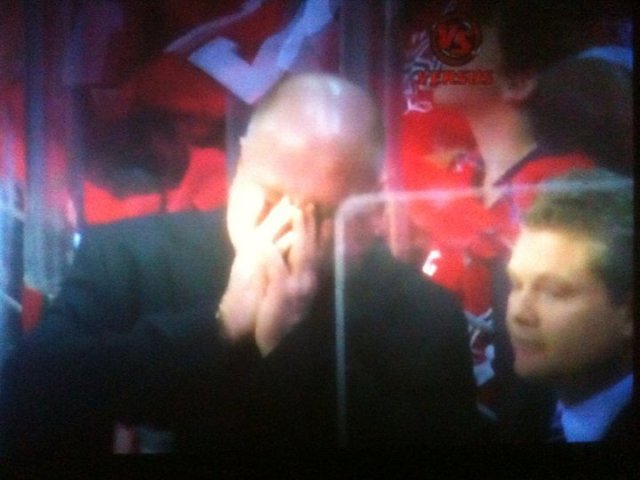
The Washington Capitals are a mess. There’s no other way to put it. And Bruce Boudreau lost control of this team. It was clear in his last few days as coach of the Capitals that he was on borrowed time. But, in that same vein, he should have been fired last spring, after the Capitals’ fourth premature playoff exit in as many years.
The fact that he decide to choose this season to make changes to the culture of the team – four years and six days into his tenure – is akin to grasping at straws.
His post-game quotes after Saturday’s 5-1 loss to Buffalo might have been the beginning of rock-bottom. Or further proof of it.
Boudreau, whose job security has been doubted with each stage of Washington’s struggles, was asked how a team finds its mettle.
“It’s got to come from within, I’ve got to believe,” the 56-year-old Boudreau said. “I’m hoping that’s got to come from within because if I’ve got to teach them how to be tough, then I don’t know quite how to do that.”
Because it was evident he had lost this team, and even more evident that he lost the man who is supposed to be his leader. Alex Ovechkin was minus-four Saturday night against Buffalo. He has scored one goal at the Verizon Center this season. He berated his coach with a few words and actions on national television.
There was clearly a discord between Ovechkin and Boudreau. If it wasn’t evident by now, then you’re just walking around wearing blinders.
That’s not to say the Washington Capitals aren’t culpable, either. The most glaring mistake the organization made in leading to this tailspin? Making Ovechkin the captain, when it clearly should have been either Brooks Laich or Mike Knuble – players known for their candor, for their roles both on the ice and in the locker room among their peers and, most importantly, for their heart. And if you hadn’t figured this out by now … Boudreau doesn’t get much respect from his peers – and I can tell you that’s a fact.
And, as evidenced by several things, he doesn’t get a lot of respect from his team. Note the players’ body language in this clip from HBO’s “24/7”:

With today’s hiring of Dale Hunter, expect that to change. Anticipate a chippier – maybe even a nastier – style of play, in which the players won’t cave and will play with a defined edge. Those were  hallmarks of Hunter’s playing career in Washington.
Which leads to my next point – the player-turned-coach is becoming en vogue, and Washington’s hiring of Dale Hunter is another benchmark of that trend. There’s a different psychology to NHL players nowadays as opposed to 15 or 20 years ago. There’s more of a need for sympathy and empathy, and I mean that in a totally non-flowers/lollipops/rainbows kind of way.
It serves Washington to pick up a younger, smarter, savvier coach, one who knows – to a certain degree – what his players are going through and how to connect with them, though while maintaining a certain amount of professional space.
Think along the lines of Kevin Dineen, Dan Bylsma, or Dave Tippett. And now that Dale Hunter has the chance to take over in D.C., he has the chance to take control – and the challenge of cleaning up that mess.

This is no fun to write …

During the last days of my trip to Maryland and Pennsylvania, I got an unsettling email – another journo friend of mine had gotten the pink slip.

At the time of his layoff, he was covering one of the Big 4 sports and, just as importantly, was/is a journo who embraced technology and social media on his beat and used it not only as a way to break news but to connect with his paper’s readers and to build a following as a multimedia reporter, not just a newspaper reporter.

And this is sad, because I really tried to follow his lead in doing that as a beat writer. Now, he and I are trading notes on what to do in, as I jokingly call it, “the afterlife.”

I’m not clear on the methodology that each newspaper or company uses to determine who stays and who goes. The protocol at my former newspaper, per the union contract: the person with the least seniority is the first to go. That was me, with only 7 1/2 years at the paper. But I can’t speak for other newspapers, and this isn’t any sort of indictment against labor unions.

However, it bothers me that relative youngsters being told to clean out their desks and that their services are no longer needed by their news outlets. We’re not just salary dumps or numbers in your books. The relative youngsters are some of the ones who are willing to embrace and adapt to and even introduce new ideas and technologies. They bring a fresh perspective and, hopefully at the same time, enough experience to contribute and to reinforce that perspective.

And they – including me – are being let go. I have a personal stake in what I’m about to say, and I hate to say it, especially given the role that newspapers have played in the history of our society and in each community. But newspapers are further mortgaging their futures by letting the youngsters go.

Getting back to personal …

There is something good about going out and having a fun time, and meeting new people – you are surrounded by people who are like you and who are different than you, you are  introduced to new ideas and you are forced to dialogue. And I mean “forced” in a totally good way. We need to communicate with each other. We, as a society, need a way to engage with each other instead of looking down at our phones and reading texts.

Our society and our economy, collectively, are in a bad place right now. And I really believe it’s up to individuals, collectively, to rally and do something about it. We may be short on cash, but we’ve got a few things to offer each other in our communities – human capital. Which comes from forming, nurturing and even rekindling relationships with people.

My friend’s husbands said some pretty prophetic stuff while I was home in the D.C. area last week. Both of my friends are small-business-owners, one is a woman I’ve known since the sixth grade, who is moving forward with her own photography business. We both agreed this – money isn’t easy to come by.

But her husband said this: in some ways we have to go back to what people in the colonial times did – barter goods and services in lieu of money. We can’t do it all the time to replace capital, but we can give someone a start by saying hey, if you can do some web work for me, I’ll shoot some photos for you. And we can engage each other’s strengths and skills in doing this.

Another husband of a friend of mine recently lamented that we, as individuals, isolate ourselves within our society.

It made me think of something that Kelly Cutrone wrote in “If You Have To Cry, Go Outside”:

“I believe the breakdown of the tribal system is responsible for much of the sickness in the world today.”

We don’t see tribes anymore. We don’t have a group of people surrounding us who can help us out and who can guide us and give us a chance, not just in the bad times but during times of prosperity. You know the whole saying, “It takes a village to raise a child”? Consider it – it’s a symbiotic thing. And why is it that the only way we find out who is truly in our corner is during a crisis?

Which leads me to the outing last night, in which I got to see some valued friends and former coworkers, and met some really cool people who granted me the privilege of some great dialogue – and even inspired me to write this post.

At one point there a lengthy conversation about the role that social media and social networking is playing in our society, and another conversation about how I recognized so many people from their Twitter avatars but was just meeting them in real life. (Is that bad?)

A consensus was reached: We can use these tools not so much as a means of communication, but as a way to facilitate a more valuable form of social networking – face-to-face communication.

And, hopefully, to build relationships.

Storify-ing

So at the urging of one of my peers, I’m turning to Storify as another means of telling a story. The premise of it is pretty simple – using Storify, a user gathers feedback from various social media outlets to piece together a story.

I haphazardly experimented with it the night Sidney Crosby played in his first NHL game of the season, providing updates after each period and a retrospective at the end of the night:

What they’re saying after Sidney Crosby’s first goal

http://storify.com/rlenzi/what-they-re-saying-after-sidney-crosby-s-first-go

What they’re saying after the second period of Sidney Crosby’s return …

http://storify.com/rlenzi/what-they-re-saying-after-the-second-period-about

A retrospective on the day that was …

http://storify.com/rlenzi/a-quick-retrospective-on-the-day-that-was

It looks something like this (just a screengrab):

So, readers, I’m asking you this – take a look at Saturday’s slate of college football games and let me know which game you think has the most fan interest, one that might be worth Storifying. I’ve gotten a few votes for Kansas-Missouri – given that it might be Turner Gill’s last game as coach of the Jayhawks and it might be one of the last meetings between the two teams … or there are just lots of people I know with a vested interest in KU-MU …

Either email me (lenzigallagher@gmail.com) or send me a response on Twitter (@rlenzi)

Things I am thankful for …

I’ll make this brief, because I know you all want to enjoy your Thanksgiving … but this is what I’m thankful for:

1. My husband and my family. The most loving, supportive people I know – and, yes, I am biased!

2. My health.

3. My friends. In a crisis, you truly find out who is in your corner. Again, I’m surprised and overwhelmed by the people who help and support me. Likewise, I hope I can do the same for them.

3. Some unexpected time off. It sounds strange to say it after receiving my walking papers and being told I can’t do something I love, but more and more I’m starting to realize that I have an opportunity to take some time off and figure out what I want to do next with my life. That’s not to say I don’t want to get back in the workforce – I get to see what other opportunities are out there.

Seriously, I hope everyone reading gets the chance to spend the holiday with the people they love and care about, and find a way to give thanks every day, even when it seems like we, as individuals and as a society, are in some really tough times.

Now go enjoy all that turkey and football tomorrow!